THE ABOVE JAPANESE TWO-MAN MIDGET SUBMARINE ENDED UP ON SHORE IN HAWAII DURING
PEARL HARBOR. THEN, JUST 10 MONTHS LATER, AFTER BEING BOMBED OFF REDONDO BEACH
A SAME KIND OF SUB WASHED UP SOUTH OF THE PIER, THE TWO MAN CREW DEAD OR MISSING
I was much too young to have fought in World War II. Years passed before I served in uniform, and by then it was a much different time and a much different war.
However, as a young boy growing up during those early war years, even though I was not old enough to have been in the military, not unlike millions of other kids, I served our country in a myriad of ways. Tin can drives, victory gardens, rationing. No gas or rubber tires. Cardboard toys. Having close friends my own age who I played with whose fathers, uncles, or brothers were fighting in the war, some lost, dying, or dead. Gold Star Mothers, Blue Star Mothers, many sharing both.
Even though my home was thousands of miles away from the raging turmoil of the battlefronts, living practically on the beach along the Pacific coast we were constant hostage to attack. Although most people don't know it or they don't remember it, the hostilities of the war visited our shores more than once, and sometimes so close it was like it was in our front yard. Japanese submarines prowled the waters all up and down the coast with shipping being hit, torpedoed, damaged and sunk. The mainland being hit with shells, bombs, and by air attacks. Sure, it was nothing like what was happening in either of the two major theaters, but happening none the less.
Now, while it is true during the years from 1941 to 1945 a number of areas were hit along the Pacific coast from Canada to Mexico, for some reason Santa Barbara north of Los Angeles to San Pedro harbor in the south seemed to be an area of concentration the Japanese focused an extra amount of effort on. Near the southern end of their interests, was the then small California beach community of Redondo Beach, the town my brothers and I grew up in during the early years of the war. Even though San Pedro was several miles further south from Redondo, because my dad worked in the shipyards on Terminal Island just across the shipping channel from San Pedro, for me as a kid, it was all tied together.
Redondo Beach was big to my family, especially in the early years as it was there my mother and father met, where my brothers and I were raised initially, and where I started school. Before the war going to the beach was idyllic and a big part of what we did. One day, and collaborated by my grandmother, I had wandered off and found by a pre-teen girl. Thinking I was lost, she took me up to the pier, bought me an ice cream cone, then took me to the life guard shack. Right away the life guards knew who I was and right away we were all reunited, with the young girl being asked to join us. She and her older sister lived inland an rode the Pacific Electric red car to Redondo. After that. every time she came to Redondo she sought us out. Then one day the war started and we and she stopped showing up. It wasn't until after the war that I saw her again.
With the start of World War II it was into the Marines then picking up where she left off with Redondo not long after her discharge. It was then she rediscovered me, bumping into me as a little boy selling corsages and boutonnieres to couples attending the dances thrown by Texas Jim Lewis and his Lone Star Cowboys late into the night. The young girl come Marine turned into big time after the war Redondo Beach entrepreneur and sports car race driver Mary Davis.
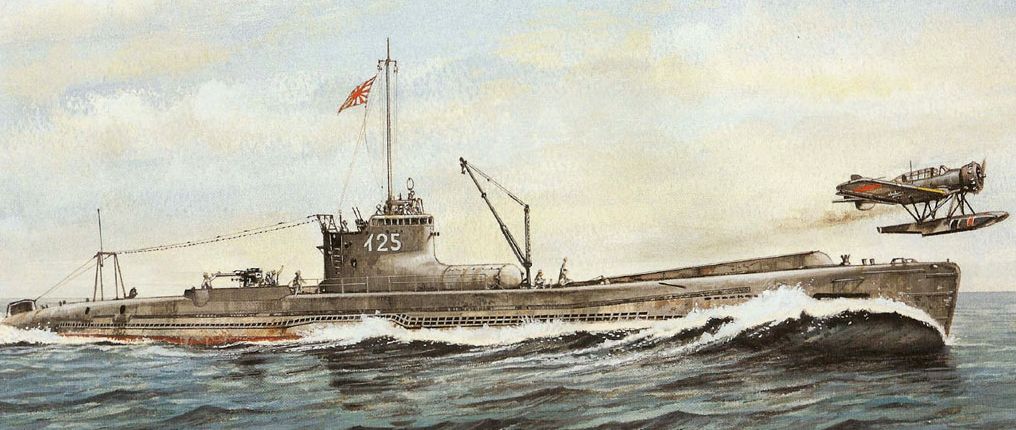
Before all of that, on December 14, 1941, seven days after the attack on Pearl Harbor, the Imperial Japanese Navy (IJN) ordered a number of submarines to the west coast of the United States to attack shipping. They were also given additional orders to strike against the continental U.S. by shelling and bombing targets of opportunity. Within days those orders were narrowed to a specific set of directives telling each of the submarines to fire 30 shells on Christmas night, December 25, 1941, into high profile targets up and down the Pacific coast. To underscore the level of importance the Japanese high command put into the successful execution of the plan all of the submarines were able to launch bomb dropping aircraft from catapults. One of the submarines even carried a Rear Admiral.
On December 22, 1941, three days before the Christmas night attack, the IJN Commander in Chief, Combined Fleet, postponed it until December 27th because on that same day, the 22nd, their Combined Fleet Intelligence Bureau intercepted a message indicating three U.S. battleships were steaming toward Los Angeles with an expected arrival date of December 25th. Four of the closest submarines spread out along the coast were redirected to rendezvous off southern California and coordinate plans to intercept and engage the battleships. The reports proved to be wrong. Without any battleships to engage the four heavily armed Japanese submarines were left sitting right on top of the San Pedro, Los Angeles harbor for the December 27th attack rather than being dispersed miles apart up and down California.
Then, for reasons unkown, the following happened:
"On Christmas day, December 25th, one of the four submarines, the I-19, taking up a position in the narrow channel between Santa Catalina Island and the mainland just off Point Fermin near San Pedro, and possibly leaning rogue or breaking rank, torpedoed and damaged the unarmed U.S. freighter Absaroka. Although the Absaroka settled up to her main deck within minutes and abandoned, the crew reboarded her and a Navy tug towed her to a strip of sand below Fort MacArthur and beached. Such a blatant attack a mile off Point Fermin within eyesight of the Naval shipyards on Terminal Island and on Christmas day besides, set off a whole slew of concerns and heightened alerts by the Americans and possibly undermined the potential outcome of an attack by the Japanese on the 27th."
(source)
The same source as the above quote says that at the very last minute on the same day of the rescheduled December 27th "land-attack" the Japanese General Staff totally rescinded the order. However, if there were any submarines left remaining in the San Pedro, Los Angeles harbor area after the I-19 attack on the Absaroka is not known because in the Oral History of Palos Verdes Estates Police Department the following is found, and where Redondo Beach comes in:
"On Christmas 1941 what was thought to be a Japanese submarine was sighted off of Redondo Beach. The Air Corps and Navy responded and dropped several bombs."
After the above bombing, newspaper headlines announced "Army Flyer Sinks Coast Raider, Air Filled with Debris as Nippon Submarine Is Destroyed."
Regardless of headlines, according to Michael H McCandless (1959-2010), a historian of sorts on Redondo Beach, any assumption that the submarine might have been sunk proved to be untrue. The idea that it WAS sunk came about because of a ton of wreckage that showed up following the bombing. Later it was discovered the wreckage was actually from the Kohala, a fishing barge anchored off Redondo. If you remember from above, the Oral History of Palos Verdes Estates Police Department is quoted as saying that a submarine WAS sighted off Redondo Beach. Then, regarding the debris, it goes on to say:
"The only thing sunk was an old fishing barge that was anchored off the coast. What was left of the barge washed ashore on the beach at Malaga Cove. It was quite an attraction for some time and a number of its parts were salvaged by local boys."
The I-19 must have left the Catalina Channel immediately after the torpedo attack on the Absaroka, apparently beating a hasty retreat north from the Point Fermin area passing by the fishing barge to the deep marine trench off Redondo and in the process the reason it was spotted.
Tracking the sub's movements when it was first seen after it left the channel until it disappeared over the horizon to the northwest is picked up by South Bay historian Marshall E. Stewart, who writes the following in his self-published book History of the Early Hollywood Riviera.
"On Christmas Day 1941 at the start of WWII the first sighting of a Japanese submarine was from the veranda of the
(Hollywood Riviera Club). Soldiers unfamiliar with the ocean were placed along the cliffs and at the Club. One of the soldiers, looking through a telescope, spotted an unusual vessel near one of the fishing barges. He asked Roy Stewart (manager of the Hollywood Riviera Club from 1930-1942) to identify what kind of vessel it was, and he recognized it as a submarine. The sighting was reported, causing a small military plane to arrive over the surfaced sub and drop a bomb. The bomb landed next to the sub on the same side as a fishing barge. The submarine moved westward on the surface and as dusk and low clouds increased, a Navy ship could be dimly be seen firing at the Japanese submarine. The bomb also ruptured the wood planking of the fishing barge which took on water until she was decks awash."
The Hollywood Riviera Club was a onetime exclusive club just south of Redondo Beach right on the bluffs overlooking the ocean where they start rising up toward and curving into the much higher Palos Verdes Peninsula. The club actually straddled the city line between both Redondo Beach and Torrance.
ATTACK ON THE SS ABSAROKA
It is known the sub eventually left the area without harm and, possibly because of her actions against the Absaroka, the December 27th attack was called off.[1]
Two months later, on the night of February 25, 1942, one of the most mysterious events to have transpired in the war, or any other time for that matter, unfolded. At 1:44 AM in the morning, a remote military radar installation that was part of a newly minted early warning system, picked up an unidentified aerial target 120 miles west of Los Angeles and closing. At 2:15 AM Los Angeles area anti-aircraft batteries were put on Green Alert --- ready to fire --- and at 2:21 AM the regional controller ordered a total area-wide blackout. Then, just minutes before the object should have come into the path of the waiting anti-aircraft guns it suddenly vanished. Soon it was seen rising up over the Santa Monica Mountains behind and to the east of the aimed direction of the anti-aircraft guns. At 3:06 AM the Santa Monica area anti-aircraft batteries turned inward toward the object and started firing out over the city following it's track toward Baldwin Hills. Suddenly "the air over Los Angeles erupted like a volcano." (source)
During the intervening period the the giant object of unknown origin, said to be 800 feet long --- the size of a Zeppelin --- withstood the continued pounding of 1440 direct hit anti-aircraft rounds with no signs of any ill effect. From Baldwin Hills it turned back toward the coast heading south past the beach cities of Manhattan and Hermosa. When it reached Redondo Beach it turned inland again then south back out to sea between Long Beach and Huntington Beach, never to be seen again. The true aspects of mystifying incident have never been answered. Some say it was the Japanese, although after the war they completely refuted any implication in the event. Others say it was pure mass hysteria.
A person by the name of C. Scott Littleton was a young boy living along the Strand in Hermosa Beach when the object flew past his house just beyond the surf-line paralleling the coast. It was Littleton's later published reports as an adult that supports the the fact that the object turned inland around Redondo Beach. It was however, not the only confirmation. Within minutes of the Littleton sighting, just south of the Edison steam plant another eyewitness confirmed the object turned diagonally inland toward the south-southeast flying almost directly over the top of the Happy Hour Cafe at 400 Strand, Redondo Beach, owned by the infamous Fifie Malouf.
DURING MY CHILDHOOD REDONDO BEACH LOOKED MUCH AS THE ABOVE, ENDING AT THE OILFIELDS
(please click image)
The following, describing the eyewitness account, is found at the Fifie Malouf link:
"(O)ne night in February 1942 right there on the Strand a huge, giant object, as big as a locomotive, came in off the ocean and flew right over the top of the Happy Hour Cafe and the apartments. (I) had heard a ruckus going on outside, sirens, guns firing, all kinds of stuff, so (I) went out on to the Strand only to see this 'thing' a few hundred feet above the beach slowly glide overhead off the ocean, not making a sound and, because of its length, taking forever to pass over."
As the object approached the top of the hill as it sloped up from the beach, it's path was picked up by a man named Edwards. Edwards, along with his father, owned and operated a neighborhood store on Garnet Street maybe a mile or so inland. The younger Edwards grew up in Redondo Beach and lived in a house on Juanita Avenue just up the street from the store almost on the top of the crest of the Garnet Street hill. Edwards was probably in his early 30s or so in 1942 when the object crossed right over his house. The following is how he recalled the event:
"(Edwards) was awakened in the darkened pre-dawn hours by what he thought was the sound of gunfire. Then the house began to rattle, then shudder, causing a few things to fall off the shelves as though a bulldozer or a freight train had gone by right out front of the house on the sidewalk or something. He ran outside just barely catching a glimpse of what he said looked like the dark black hull of a 'flying ship' cresting over and going down the hill toward Torrance Boulevard. He raced inside, threw on a pair of shoes and a jacket over his pajamas and ran out to the top of the hill thinking all along that whatever it was crashed into the houses on Lucia Street or into the oil fields beyond. When he got to the top of the hill none of the houses were destroyed, nothing was on fire, and there was no sign of the object."
(source)
Then, not very many minutes after it had been seen in the sky over Redondo Beach, the object was out over the agriculture fields that existed in those days a few miles inland east and south of the beach cities. That same night a young man and recent college graduate named Albert Nozaki was helping guard a relative's field from vandals that had been ruining crops and breaking irrigation systems because, he thought, they were Japanese. Below describes what Nozaki saw that night in the early morning hours:
"(A)pproaching him well above the fields from the west, silhouetted against the slightly lighter night sky, was a fairly huge dark airborne object coming straight toward him at a fairly quick pace. At first it seemed as though it would take a path off to the right of where he was standing, but before it reached him it just barely began turning flatly toward the south, almost as in a controlled drift. By then he was just under the edge of the object as it went over him with the center off to his left, continuing its turn and eventually disappearing in the southern night sky while all the time gaining altitude. It was huge, dark, very long and wide with no lights or signs of windows. Although it did not have protruding wings like an airplane, the object's outside edges ominously curved down. As well, other than feeling a slight vibrational 'hum' in his chest as it passed over, the object made no sound."
Nozaki, who later went on to be an Oscar nominated art director, apparently drawing upon his his experiences in the field that night in 1942, designed the terrifying Martian flying machines seen in the 1953 movie War of the Worlds. Without any real answers to what the object might have been, a strong string of out-of-this world extra-terrestrial connontations has blanketed the phenomenon, of which such an angle, pro and con, is explored as found in The Battle of Los Angeles: 1942 UFO.
Although I remember the events of the so-called Battle of Los Angeles on February 25, 1942 quite well I have no personal recollection from the same period regarding the aforementioned barge, the Kohala, being accidently bombed off the coast of Redondo Beach just two months earlier on Christmas day, 1941. It could be my parents, possibly thinking it was an enemy submarine so close to Redondo, may have purposely chosen to withold knowledge of the events of that day from my brothers and me because it WAS Christmas day. The thing is, even the Japanese say they were not involved in the Battle of Los Angeles incident --- so, in that sense the Battle was not exactly "war related," like say the barge situation was. There are however, two actual physical World War II Japan versus the United States war related events I personally saw and still remember quite well --- although both were apparently minor in the overall scheme of things and neither show up anywhere in history books I have ever been able to find.
One was in Santa Barbara, the other in Redondo Beach. Chronologically the Santa Barbara event happened a few years after the Redondo Beach one, but I am presenting the Santa Barbara incident ahead because I want to close with Redondo.
When the war started, as far as I knew, my mother was well and healthy. Such was not the case. As the war wore on she appeared to be sicker and sicker. Eventually she was diagnosed with an inoperable brain tumor, a tumor that impacted her daily activities and in the end led to her being totally incapacitated and death at a very young age.[2] During that lead up period to her total incapacitation it became increasingly more difficult for my father to care for her as well as take care of three young boys, so much so that he decided to investigate the possibility of a full time care facility. One of the facilities he looked into was an around the clock full care sanatorium-like hospital in Santa Barbara. The day he went to see it he took me and my mother along. While we were there we went out on the Santa Barbara pier. Somewhere along one edge of the pier was a crane-like boom that was in the process of pulling an airplane out of the water and placing it on a flatbed trailer. To me the plane was what I would call a seaplane. On its wings and behind the wings on both sides of the fuselage were clearly distinguishable bright red circular Japanese insignias. The plane was intact and showed no signs of visible damage. Years later I would identify the plane as a Yokosuka E14Y Floatplane. Where such a plane could have originated only to be found abandoned in and around the California Channel Islands, then put onto a waiting flatbed trailer on the dock in Santa Barbara and hauled away to never be seen again, although unclear, has been semi-explained in The Sinking of the Liberty Ship SS Lewis Cass. Personally, for me it still remains a mystery. So too, as it is, the whole of the year remains somewhat fuzzy or unclear to me, but the Santa Barbara plane-thing I think most likely occurred early in the year of 1943 and for sure before the end of the year because by Christmas of 1943 I was in India, not returning until the summer of 1944.
The first part of 1943 can be fairly well substantiated as well. My dad was an air raid warden on our block and for several blocks around and did a lot of what I thought was really neat air raid warden stuff. Wanting to be like my dad I mimicked him in a proud sort of way by answering an ad in a comic book for a Junior Air Raid Warden Kit, thus becoming, at least as I viewed it, an air raid warden myself. I know the advertisement began appearing as early as February 1943, meaning most likely, by taking into consideration the cover date lead time, the ad was showing up on the magazine stands by sometime in mid-late December 1942 or at least by January 1943. Knowing me and how I responded to other like offers plus how important being an air raid warden meant to me personally I was most likely chaffing at the bit to get one as soon as I could, so I'm sure by early February 1943 I had one.
FYI, the E14Y floatplane was typically launched from a B-1 type Japanese submarine. To my knowledge there is no record of a B-1 type submarine operating that far south along the coast during the time period I saw the plane being lifted out of the water. But, no record doesn't mean there wasn't as the above cited SS Lewis Cass link will attest to.[3]
The second of the two war related events I really remember involved a two-man Japanese Midget Submarine that washed up on the beach just south of the Redondo Beach pier --- an event that goes totally unreported for some reason. A then Redondo Beach resident named Max Harris and an avowed eyewitness to the midget sub washing up on the beach, who would be well into his 90s now if still alive, was age 26 at the time and, extrapolated from his own words, describes how he recalls the event:
"It was a quiet morning around 10:00 AM and me and my girlfriend were walking along the beach. All of a sudden out of nowhere, six American bombers flew right over us and started dropping bombs about 500 yards from the shoreline. They then circled back and did it again, dropping at least 50 bombs and then flew away. The next thing I knew about 200 soldiers appeared and they quickly closed the beach.
"Later that day radio news broadcasts said that a Japanese two-man submarine had been sighted off the coast of Redondo and it was destroyed. Two days later the submarine washed up on shore and inside they found the bodies of two Japanese Naval officers."
(source)
Harris has cited the date of the above event as being October 4, 1942. It is not clear exactly what the date Harris gives signifies. Since the sub took two days following the bombing to actually show up on the beach, when Harris says the 4th, does he mean the day of the bombing was the 4th thus indicating the day the sub washed up on shore was the 6th? Or does he mean the day the sub washed up was the 4th meaning the sub was bombed the 2nd?
Why is it important? It has to do with HOW the sub was able to end up being off the coast of Redondo Beach in the first place. I remember a different date, maybe only a few days later, but enough days to allow the submarine to be off Redondo on a more-or-less "official record" basis.
------
ALMOST ANYONE KNOWING REDONDO WOULD RECOGNIZE THE COLOR PHOTO ON THE RIGHT AS BEING ALONG THE ESPLANADE
THE OCEAN OFF HERMOSA BEACH LOOKED THE SAME THE NIGHT OF THE LA UFO
(please click image)
My brother's birthday is more toward the middle of October. Since his birthday fell on a weekend in 1942 my parents decided to give him a surprise party. To pull it off required my brothers and me to be out of the house while it was being decorated and guests, friends and kids secretly arrived --- so my dad took us to the beach for a walk. It was not unusual to wander along the sand with one or the other or both of our parents, or even grandparents, so it was no big thing. However, we invariably hunted moonstones on what was called Moonstone Beach in front of the Strand that ran north of the pier in those days near the previously mentioned Happy Hour Cafe. Instead, this time, no sooner had we reached the Strand than we worked our way south of the pier to see a highly-muted town event, a two-man Japanese midget submarine that had washed up on shore. Even though the sub was roped off blocking any formal access from the front, to get to it my dad took us along a narrow strip between the Horseshoe Pier and the rocks, crossing under the pilings of the straight pier along the surf line and onto the beach proper. When we reached the sub he lifted me up and I was able to look inside through an open hatch.
A handful of well armed GIs, if not toting rifles slung over their shoulders were at least carrying side arms, whose job it was to apparently guard the submarine in some fashion from incorrigibles or worse, had repositioned themselves some distance from the immediate vicinity of the sub to the somewhat more palatable sidewalk above the beach in order to interact with a few of the more viable members of the local female population. Eventually one of the GIs saw us climbing all over the sub and waved us off with no shots fired.
A few days before, within minutes of the midget submarine being spotted 500 yards off the Redondo Beach pier, a half a dozen airplanes dropped bombs from her last known position to all along her suspected path of travel. Two days later the sub, although virtually undamaged, washed up on shore. The date of the event has been reported as being October 4, 1942, although it doesn't really matter much that the bombing occurred in October but that I personally saw the midget submarine within days of it washing up on the beach --- and I remember quite clearly seeing it with my dad --- we were there that day because we had to be out of the house for my brother's birthday
Six planes dropped 50 bombs a quarter mile off the beach at 10:00 in the morning! That is a heck of a lot of bombs and a WHOLE lot of noise, especially so early in the day on whatever day or date it was done. One would think I would recall specifically such a major noise making event living only a few blocks from the ocean and straight up from the pier. The thing is, the thumping noise of explosives had become common place. Not long after Pearl Harbor the military installed two 155mm guns of the end of the Redondo Beach pier as well as anti-aircraft guns a short distance away just above the beach south of Redondo by the Hollywood Riviera Club. They were constantly test firing the things, so much so that in the case of the anti-aircraft guns the continued pounding of the ensuing target practice structurally damaged the club so much it actually had to close the place in 1942.
ONE OF TWO 155mm GUNS PLACED ON THE END OF
REDONDO BEACH'S PIER, DECEMBER 1941 TO 1943
By October 1942 most if not all of the Japanese submarines, except for the I-25, had departed the west coast for other areas of operation. The whereabouts of the I-25, which had just participated in the aerial bombing of Oregon on September 9th and the 29th, was known to still be off the south Oregon coast on October 4, 1942 because on that date she torpedoed the 6,653-ton American tanker Camden. Two days later on October 6th the I-25 sunk the 7,038-ton American tanker Larry Doheny somewhere south of Cape Sebastian. Thereafter it is said to have departed the Oregon coast arriving in Yokosuka, Japan October 24, 1942 for overhaul. During the 20-day span that lapsed between the September 9th aerial attack on the U.S. mainland in Oregon and the second one on September 29th, the I-25 embarked on an extremely top secret mission involving the release of the midget submarine that ended up being bombed off Redondo --- a mission that one day, once it came to light, would reveal a top secret Japanese plan embracing the uncontrolled unleashing of a nuclear weapon against U.S. soil along the Pacific west coast, more specifically the Los Angeles basin.
FUTURE MOTHER SHIP LAUNCHES FIRST OF TWO AIR STRIKES AGAINST OREGON IN SEPTEMBER 1942
(please click image)
On the 10th of September, one single day after the I-25's first aerial bombing of Oregon, which was for the most part was so ineffective it was basically unknown at the time --- and basically still is --- an Army Air Force maritime patrol bomber out of McChord Field in Tacoma, Washington, not searching for the sub but on routine patrol, caught the I-25 exposed on the surface with a number of crew members on deck. The sub managed to crash-dive eventually escaping with no damage after the bomber dropped a whole bomb bay of explosives on her (some reports cite anywhere from 3 to 10 depth charges unleashed by the bomber). A few days later, well off the Oregon coast and no longer being pursued --- and apparently what the crew was on deck making preparations for --- the sub took on a two-man midget sub. The sub was apparently offloaded from an armed merchant ship or commerce raider, with all fingers pointing to the Japanese transport ship Hakusan Maru, she being escorted at the time in the open seas south of the Aleutians by the Japanese submarine RO-64, both vessels operating out of the occupied island of Kiska, Alaska.
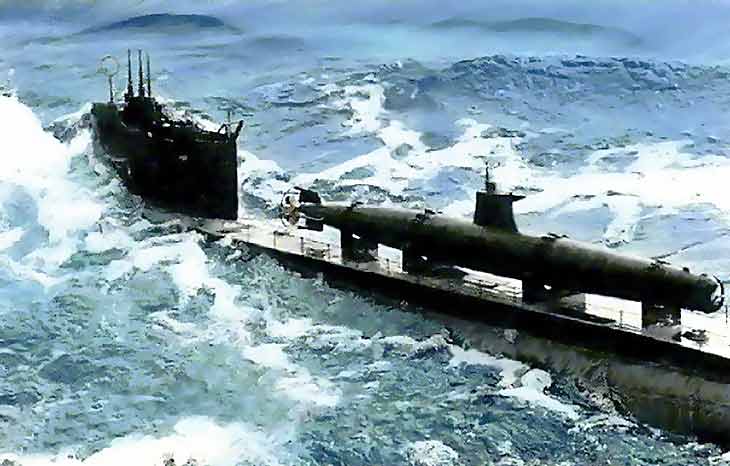
Midget subs, which had a short range of operation, typically carried only two crew members, and had to be launched from a mothership, of which the I-25 had the capability of being, and as clearly shown on the map to the right, transported it south, leaving it and it's crew in the shadow of one of the Channel Islands, most likely Santa Barbara Island, 38 miles off the southern California coast or San Nicolas located 76 miles south west of Redondo Beach. There the midget sub lurked for several days up to a week or two waiting along the beach or one of the coves for the right time to strike or complete its mission.[4]
It should be noted that B-1 type submarines like the I-25 that carried and launched the midget sub had a 14,000 nautical mile range. The home base for the I-25 was thousands of miles across the Pacific Ocean from the U.S. on the Kwajalein Atoll in the Marshall Islands. It was scheduled to arrive in Yokosuka, Japan October 24, 1942 for overhaul after having left Kwajalein ten months earlier, on January 11, 1942.
When the I-25 departed the waters off Oregon in September and headed south to release the midget submarine it had already transited clear across the Pacific and been prowling up and down the U.S. Pacific west coast close to ten months, soon after-which it was low on or had no torpedoes as well as running low on fuel and provisions. It is my belief the I-25, after launching the two-man sub on or near one of the Channel Islands she continued south to the La Palma Secret Base seen and reported on by American espionage agent and actress Rochelle Hudson as being located in the estuaries near Acacoyagua, Chiapas, Mexico. There she refueled and took on supplies --- then returned north, of which one would think to retrieve the midget sub and/or pick up it's crew. However, on September 29th the I-25 was back in northwest waters, having bypassed both Redondo Beach and the Channel Islands because it is a known fact she launched a plane to set fire to the Oregon forests on that date. Then, a few days later, on October 4, the same day the midget submarine was bombed off Redondo, the I-25 torpedoed the 6,653-ton American tanker Camden in Oregon waters. Two days after that, on the 6th, she sank the 7,038-ton American tanker Larry Doheny somewhere south of Cape Sebastian.
Following the semi-successful attack against the tanker Camden which, although on fire, did not sink until seven days after being torpedoed, and the more successful attack against the Larry Doheny which sank immediately, the I-25 departed the Pacific west coast altogether, arriving in Yokosuka, Japan October 24, 1942. The question is, was the crew and midget sub left out to dry or had the I-25 picked up the crew on the way back north leaving the sub abandoned only to end up floating unmanned off Redondo? Although it is known the I-25 as a mother ship had the ability to launch a midget sub it isn't clear that she could float under one or actually pull one out of the water and safely reattach it on her aft deck. Hence, if such was the case, i.e., not being able to reattach the sub, crew or not, the two man sub would have to be left, albeit most likely scuttled.
JAPANESE TWO-MAN SUBMARINE MOUNTED ADJACENT TO THE MOTHER SHIP'S CONNING TOWER
(please click image)
As for the midget submarine, although there were plenty of targets in the north around Seattle and San Francisco for both full-size and midget submarines, there were no known substantial hard targets that fell into the range of capabilities of a two-man sub in the general Los Angeles area. No U.S. aircraft carriers, battleships, or other major naval vessels or warships like up north. Nothing coastal that could have been impacted adversely enough to warrant such a mission either. At the time the midget sub was thought to have been dealing with a soft target, say like the pick up or delivery of documents, maps or blueprints or a high profile person, most likely a spy, saboteur, or turncoat. In that there were only two naval officers said to have been on board, if they were delivering, it is not known if our military interceded or confiscated whatever it was prior to or after the bombing OR if the sub's crew had already transfered the package to the mainland, with the whatever it was blending into the wartime milieu of America.
Why the two-man sub was running close to or on the surface at 10:00 AM in broad daylight right off the coast of Redondo Beach and WHY Redondo Beach, is not known, although the quoted paragraph below sheds light on the prime suspected possibility. Nobody knows if the sub was coming or going or which direction it was traveling. If it had been positioned due west by it's mother ship off one of the Channel Islands there would be no practical reason, military or otherwise, for the sub to be transiting the blight in a north-south direction paralleling the South Bay coastline during daylight hours. Same with east-west. Midget subs only carried a small air reserve and not much under surface battery power compared to conventional subs, but usually had sufficient supplies of both for any mission assigned. The midget submarine may have already completed it's mission and abandoned. As well the mission may have involved San Nicolas Island, re the following from the source so cited:
"Top of the list was the then little known, never before built nor never before tested theoretical weapon called the atomic bomb. The brain trust that was eventually put together to design such a weapon knew that once constructed, before it could ever be used formally, some form of the weapon would have to be tested --- and that any test would have to be done in some isolated spot without prying eyes, with minimal concern for destruction and radioactive fallout. Top secret at the time, several locations were suggested, of which one was San Nicolas Island, the most remote of the California Channel Islands."
(source)
Harris reported two dead Japanese were found on the sub which means at the time of the bombing the sub wasn't abandoned by it's crew. Nothing about the Japanese officers or their fate has ever been revealed. But, if they were still alive at the time of the bombing or already dead is not known. I saw the sub on the beach within a day or so of it washing up and to my knowledge no bodies were found in conjuction with the sub. Even though there is very little that could be much more blatantly obvious than an enemy two-man sub washing up on a public beach in a highly populated area, let alone with two dead Japanese officers, the whole incident must have been super-sensitive on BOTH sides because it was kept quiet at the time and very little or nothing has surfaced regarding the event since.
It is odd that after all these years not one official has come forward with details of what happened. After all, Harris is quoted as saying "200 soldiers appeared and they quickly closed the beach." That is an awful lot of witnesses, and for sure, not all of them could have had security clearances. If the two dead naval officers died in the line of duty, out of courtesy, more than likely their bodies were returned to Japan, so another sizable group of non security clearance personel would have been involved.[5]
I find it even more odd that in 1942, Harris, who was age 26 at the time, single, and apparently in good health --- he said he was with his girlfriend and when his article was made public he was in his 90s --- was not in the military himself, especially being it was at the height of the draft. Nowhere does he claim any military or service connected affliation in what he writes. It could be he was actually in a more official capacity than he was willing to say.
As found in The Wanderling And His High School Chums, just as I started high school I returned to living in Redondo Beach after having been gone all of my elementary school years --- albeit living as close as Hermosa Beach for awhile during the second or third grade. No sooner had I entered the ninth grade than I found a part-time job running errands several days a week for a house-bound former merchant marine who lived around the corner and up the street from my house. The ship he was on during World War II was torpedoed by German U-boats off the coast of Florida just at the beginning of the war. He was severely burned when he was forced to jump overboard into oil burning along the surface of the water. Over the two-year period or so I worked for him we became friends. One day returning from my errands my Merchant Marine Friend introduced me to a man who was visiting him as they were discussing various aspects of submarine warfare. One of the topics that came up was the two-man sub that ended up on the beach next to the pier in Redondo. When I interjected that my father had lifted me up to see inside the sub the man got all excited and went on and on about it. If that man was Max Harris or not I do not know. He was however, the only person I knew that ever talked about it much.[6]
AND NOW THIS
In December 1959, seventeen years after the October 1942 two-man Japanese midget submarine washed up on shore just south of the Redondo Beach pier, only to disappear a couple of days later without a trace, a diver by the name of Bob Bell reported finding a previously undocumented submarine laying on the bottom in 60 feet of water off the Los Angeles Harbor breakwater. According to newspaper articles dated December 27, 1959 Bell, who was said to have owned an industrial diving service, was led to the site by a Long Beach diver named Bill Stach. Bell, as cited by the articles (linked below), suggested because of the sub's less than traditional size it was possibly one of a group of small subs brought across the Pacific by mother ships.
Almost immediately follow-up articles were published discounting the possibility of Bell's find being a Japanese sub. Former Imperial Japanese Naval officers reportedly doubted that a Japanese sub was sunk off the L.A. Harbor in World War II. According to the Japanese Disabled Veterans Association, Imperial Navy records showed no submarines lost near Los Angeles throughout the entire annals of the Pacific war.
Bell said he had "read in a book" that a Japanese submarine named Sakuri had been sunk off Point Fermin Christmas day 1941. The Japanese made it clear that they did not name their subs but used only identifying letters or numbers (which is true). The thing is, the Japanese submarine involved in the Christmas day attack was not in any sense of the word a small submarine like Bell's, but instead, like the Japanese said, a numbered sub, more specifically the I-19. The I-19 was a huge Type B-1 trans-oceanic vessel capable of launching an airplane --- which would place it more into the catagory of a "mother ship" than being similar to the Bell find. The I-19's history, including the Christmas attack clear through to it's utimate demise February 2, 1944 with a loss of all hands near the Gilberts Islands area, is fully documented and accounted for.(see)
Because of Naval records we know the submarine that Bell found could not have been the I-19. It is also highly unlikely, as some have claimed, that instead of a Japanese sub, he might have stumbled across the World War I German submarine UB-88. The UB-88, a World War era German submarine was scuttled by the U.S. Navy on January 3, 1921 after being towed to an area off Los Angeles in San Pedro Bay and sunk by gunfire from the destroyer USS Wickes. After years of uncoordinated on-and-off searching by a variety of dive teams she was finally located by sonar in July 2003. On August 27, a dive team reached the wreckage providing the following regarding their find:
"A slender, preserved hull, diving planes, torpedo tubes conning tower, two shell holes from the USS Wickes' four-inch deck gun and a measured length of 190 feet and 19-foot beam confirmed the wreck to be the elusive UB-88. Fabian has not revealed the location or depth of UB-88 but says she is well beyond the range of sport diving."
(source)
In comparison, the typical Japanese midget submarine, as pictured at the top of the page for example, was at least half the size of the UB-88, measuring 78.5 feet in length overall, with a 6.1-foot breadth and a 6.1-foot draft. Bell's description of the sunken vessel he saw underwater off the breakwater comes across as though it wasn't nearly as large as the typical crew of 70 men and 10 officers independent ocean-going or "wolf pack" type submarine --- as he presented it, in size it's configuration more closely resembled that of a two-man sub saying it was "a small sub similar to ones brought across the Pacific by mother ships."
There seems to be no record of what happened to the two-man sub I saw as a young boy on the beach just south of the Redondo pier, for all practical purposes it simply disappeared off the face of the earth --- or, as I suspect, under the sea. If Bell's story carries any validity I think the sub that washed up on the beach in Redondo and the one he found is most likely one and the same. There are a few discreprencies in how the facts that have come down to us are interpreted, but none that can't be overcome. In the articles the attempt is to tie his find to the Christmas day attack on a sub spotted off Redondo, which we know is just not the case because the sub involved in the Christmas day event was not a midget submarine, but a full-size tran-oceanic craft. It is also related in one of the articles, continuing to tie it to the Christmas event and quoting marine sources, albeit unnamed, that it would be possible with prevailing currents the disabled sub could have drifted around the Palos Verdes peninsula and finally sunk off Point Fermin.
That possibility is a real stretch. I crewed on and off for awhile on a yacht come marlin boat owned by the multi-millionaire David J. Halliburton that spent some of its time in Cabo San Lucas and some of its time moored in Marina Del Rey. In so saying, I have made several trips up and down the coast at different times of the year. I can tell you there probably is not many more places in the world that has as much screwed up currents as those that are found along the southern California coast. For one thing, even though the California Current is the prime driver as it heads south from the northern Pacific, as it reaches the channel islands some of it splits somewhat to the east between the islands and the mainland with the main portion of the current staying west outside the islands. That less powerful southward flow between the islands and the mainland meets up with what is called the inshore counter current --- which flows north right along the coastline up from San Diego and below. Although the inshore counter current is variable --- in position and strength at different times of the year --- usually the two clash just off the coast of Palos Verdes between Point Fermin and Catalina Island causing a whole series of eddies, some turing clockwise, some turning counter clockwise.(see) To imply realistically that a disabled sub or anything else would drift from off the coast of Redondo Beach to where Bell found a sub off the Los Angeles breakwater in 60 feet of water is taking a lot of potential uncertainties into consideration. If you remember from the above:
"The only thing sunk was an old fishing barge that was anchored off the coast. What was left of the barge washed ashore on the beach at Malaga Cove. It was quite an attraction for some time and a number of its parts were salvaged by local boys."
What was left of the barge washed ashore on the beach at Malaga Cove --- none of the sub. You can't have it both ways. I will tell you what I think happened. To do so you have to forget the Christmas 1941 attack and jump to the October 1942 two-man midget submarine --- two separate incidents. Whatever the two-man sub was involved in, authorities on both sides of the action did not want it to get out and in my estimation they still don't. Previously, in the main text above, I wrote that there is very little that could be much more blatantly obvious than an enemy two-man sub washing up on a public beach in a highly populated area. The whole incident must have been super-sensitive on BOTH sides because it was kept quiet at the time and very little or nothing has surfaced regarding the event since --- that is, UNLESS you take into consideration Bell's find.
Bell said when he came across the sub in 60 feet of water the hatches and compartments were secure but the bow seemed to have been blown off. When my dad took me to see the midget sub, if you recall, he held me up in some fashion to look into the open hatch. So too, I do not recall any portion of the craft, fore or aft or anywhere else, damaged or open as in not being there (i.e., blown off). As I remember it the sub was "whole." It is my suspicion that under the cover of darkness a small quick-strike military team, in a rather intensive secret retrieval operation, quietly and covertly pulled the sub off the beach and towed it around Palos Verdes Peninsula toward some designated and secure place within the Naval docking sheds or warehouses inside the L.A. harbor. Coincidently enough, for the record, the travel route being towed from Redondo Beach would pretty much duplicate the unnamed marine sources contention that 'with the prevailing currents the sub could have drifted around the peninsula and sunk off Point Fermin.'
As to being sunk, since it would have been in the hands of friendlies, how or why it was sunk is a good question. Most likely the sub was either being taken to a place within the deep confines of the Naval facilities inside the breakwater where it would be far removed from prying eyes then gone over with a fine tooth comb OR it was simply scuttled to remove it from history. Which one, if either, is not known. That is to say, while being towed did the sub sink before it ever made it inside the harbor or was it thoroughly gone through and examined at a secure spot inside the breakwater then towed back outside and scuttled?
Bell said the bow appeared to be blown off. When I saw it I am sure the sub was whole. A number of scenarios are in play here. If you went to the linked page on the German submarine UB-88 you would have learned that inside the wreck was a 25-pound cache of TNT designed to sink it if the shellfire intended to scuttle it proved ineffective. It could be that a similar explosive device was placed in the midget sub prior to transit to ensure that it wouldn't fall into the hands of someone unintended (remember, we were still at war at the time). If such a device was placed onboard it may have gone off prematurely while still outside the breakwater. A concerned reader has told me there is the possibility, however remote, that one of the torpedoes could have exploded accidently while being removed from the launch tubes prior to entering the harbor. So too, the sub could have met it's fate at the hands of unfriendlies on route and more of a reason to keep the whole thing secret --- especially if there was a loss of American lives. Most likely what happened the sub was dealt with by authorities inside the breakwater, then, if not cut into tiny little pieces by blowtorches, towed back outside and like the UB-88 simply scuttled.
The following links are newspaper articles refering to Bob Bell and his find:
Divers To Try Salvage Of Sunken Japanese Sub
Japanese Officers Doubt Sunk Sub Yarn
Japanese Deny Submarine Sunk Near Los Angeles
For more on Bob Bell click HERE
Several years before Bell's find, actually just one short year after the war, in August 1946, a former Navy hard hat diver named Glen Dean 'Tonga' Stainbrook (1921-2001) reported knowing the whereabouts of and diving on a sunken sub in 180 feet of water in the Catalina Channel a mile off White's Point, Palos Verdes Peninsula. Stainbrook said he discovered the sub while in the Navy and after his discharge dove on it several times. Newspapers articles of the day reported that he actually got the bends diving on it as well as saying that on one of his dives he found four skeletons, all carrying Japanese identification. I question the validity of "four skeletons" and for sure, four skeletons, if they were human, would most certaintly discount his "find" being a two man sub, of which where my interest here are.
Finds Japanese Submarine Sunk Off West Coast
Diver Seeking Sunk Jap Sub Gets Bends
Japanese Submarine Sunk Off West Coast Located By Diver
For some reason in all of the above articles Stainbrook insists the submarine he found was the same sub that attacked the SS Absaroka. However, the Japanese submarine I-19, known to have been the sub involved in the torpedo attack off White's Point that day, went on to kill again before its actual overall ultimate demise on November 25, 1943. It is officially recorded as racking up considerable damage and sinking of a number of other vessels prior to that demise --- and not just unarmed freighters either. For example, on September 15, 1942, the I-19 fired a half dozen torpedoes at the aircraft carrier USS Wasp, two of which hit and sank her. The remainder of the four torpedoes hit and damaged the battleship USS North Carolina as well as the destroyer USS O'Brien which sank later. Stainbrook claims that the sub he located off White's Point was one and the same sub that sunk the Absaroka is either because it was so close to the end of the war he didn't have all the facts OR it was out-and-out subterfuge on his part.[7]
Since his find was said to be in 180 feet of water and a mile off shore it has been suggested it was the UB-88. If it was or wasn't the UB-88, even though Stainbrook is quoted as saying he was given permission to raise the sub, to this day to anyones knowledge nothing was ever done. A full 57 years passed before a local Los Angeles sports fisherman named Gary Fabian and a long time dive boat operator named Ray Arntz teamed to search for the UB-88. After fourteen months of extensive weekend searching, on July 9, 2003 the wreck of a vessel thought to be the UB-88 was picked up by sonar. A search team was put together that included technical divers Kendall Raine and John Walker, and later Scott Brooks and Fred Colburn to confirm the find. On August 27, 2003 Raine and Walker made the initial dive, and in doing so officially became the first to lay eyes on UB-88 since she was scuttled 82 years earlier. There was no mention of skeletons.
Although Fabian and Arntz released a sufficient number of documents and photographs to easily confirm their find was ligitimate they never released the exact location of the submarine except vaguely. Then, three years later, in July 2010, a diver by the name of Phil Garner using his knowledge of the sea and extrapolating clues from the works of Fabian and Arntz along with his gut instincts, independently located her. His instincts went thus:
"They would have to tow the sub far enough offshore to avoid launching a torpedo onto someone's front porch. Open ocean is south of the Long Beach Naval Shipyard. I drew a line directly south of the old Navy base and followed it until I found a depth between 175 feet and 182 feet. There were only a few targets in the area, but one of them was exactly ten miles south in 178 feet."
(source)
Ten miles directly south of the old Navy base. If such was the case, and apparently it is, the so said location of the UB-88 would eliminate the potential possibility of Stainbrook's find while diving on a sunken sub in 180 feet of water in the Catalina Channel he reported as being a mile off White's Point, Palos Verdes Peninsula. Those are two entirely different locations, two different to make the UB-88 and Stainbrook's find as being the same sunken vessel.[8]
The above graphic is most generally attributed as depicting the U.S. Navy salvage vessel USS Current (ARS-22) conducting a salvage operation on July 6, 1960 of a Japanese World War II era two-man midget submarine that had for 19 years, been laying on the ocean floor of the Keehi Lagoon just outside Pearl Harbor having being sunk on December 7, 1941.
The USS Current, after completion of her own noble service during World War II was reassigned. Between April 15, 1946 and July 22, 1947 she served with JTF-1 on Operation Crossroads, an atomic weapons test program conducted in the Marshall Islands. With the ending of the tests the Current returned to San Diego, California and eventually placed out of commission in reserve February 9, 1948 only to be recommissioned a few years later (October 10, 1951) for service in the Korean War. She left Long Beach, California December 7, 1951 arriving in Pearl Harbor one week later continuing in service through the Vietnam War.
The quote below is found in Footnote [7] on this page referring to a meeting that occurred between the aforementioned Glen Dean 'Tonga' Stainbrook and myself in the early mid 1970s:
"It was Jere Lee's connection with E.R. Cross, then through to me because of my connection to Pauline Page on to Stainbrook that allowed me to catch up with Stainbrook on a one-on-one basis. With that catching up I was able to discuss with him at length on a personal level about the submarine he was said to have explored and what he did or didn't find."
Stainbrook had a copy of the exact same photo depicted above. He also had a second almost duplicate photo that when comparing the two was almost indistinguishable, one from the other, clearly showing the same ship the USS Current and as well, if not the exact same type, nearly so, of the two-man Japanese submarine being held aloft in the same fashion or manner.
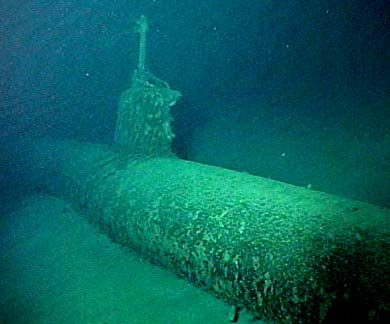
The difference according to Stainbrook was, wherein the above photo was said to have been taken in 1960 in the Keehi Lagoon, Hawaii, the second almost duplicate photo he had was taken in the late 1940s in the San Pedro shipyard channel during the period of time the USS Current was in California just before or during the time she was said to be out of commission. In another difference voiced by Stainbrook, most references to the Hawaii photo indicate the midget sub was being hauled out of the water while the picture he had there were no references one way or the other as to which direction the sub was being hoisted, that is into or out of the water. One thing Stainbrook did know was, he thought it was odd, like the San Pedro sub in the photo he had which was taken in the late 1940s, the Hawaii sub was also clean or slick, showing no signs of encrustation by sea animals after all those years. The graphic below is an example of another midget submarine, like the Hawaii sub previously cited, that too was sunk on December 7, 1941, and found on the ocean floor in Hawaiian waters. Notice it's hull is alive with creatures:
VETERAN'S ZEN
KP TO ENLIGHTENMENT: ONE SOLDIER'S PATH TO ALLEVIATING STRESS,
DISSIPATING ALL THE THE BULLCRAP AND LAYING LOW THE FOG OF WAR
(please click any insignia)
THE REDONDO BEACH HISTORICAL MUSEUM
The Redondo Beach Historical Museum mission statement is to bring together those persons interested in history, especially the history of the City of Redondo Beach, to promote, preserve and protect the historical and cultural resources of the City.
Fifie Malouf, the overflight of the city by a giant unknown object in the middle of the night that had taken 1400 rounds of anti-aircraft ammunition without incident, Japanese midget submarines washing up on shore next to the pier. Every now and then I get an email from someone who tells me, after having visited the Redondo Beach Historical Museum and carrying on a casual conversation with museum staff mentioning something they recalled from material of mine regarding some aspect of Redondo Beach they came across, it is not always received with full 100% substantiating results --- in other words, it gets pooh-poohed.
I was, however, pleasantly surprised by an email I received one day in relation to the gist of the contents of the above quote and finding within the email the mention of the name of a person from my old Redondo Union Beach High School days I recognized, Tike Karavas. Please see:
CONSTANTINE 'TIKE' KARAVAS
OF THE REDONDO BEACH HISTORICAL MUSEUM
SEE ALSO:
OF COBRAS, SCARABS, MASERATIS, AND ZEN
SAN CLEMENTE ISLAND AND THE 1942 UFO
DOING HARD TIME IN A ZEN MONASTERY
NAZI PLOT TO BLOW UP HOOVER DAM
THE JAPANESE SECRET WAR
THE SHIPWRECKED SAILOR
THE FLYING TIGERS
THE BOY IN THE MAN REMEMBERS THE LEGEND
THE WANDERLING
(please click)
As to the subject of donations, for those who may be so interested as it applies to the gratefulness of my works, I invariably suggest any funds be directed toward THE WOUNDED WARRIOR PROJECT and/or THE AMERICAN RED CROSS.
FOOTNOTE [1]
In the book Harbor Defenses of Los Angeles in World War II, the authors take a little different view of the event than what the local eyewitness recall:
"At approximately 1400, 25 December 1941, a slow moving submarine, which appeared to be disabled, was identified in a position approximately 4000 yards off shore near Redondo Beach. It is probable that this submarine was the one which was disabled by the destroyer depth charge attack the previous day. Due to the submarine's position none of the fixed Harbor Defense batteries could be brought to bear on it. Fortunately this contingency had been foreseen and Battery F, 105th Field Artillery Battalion was ready as a roving battery to meet the situation. One 75mm gun from this battery was immediately dispatched from Fort MacArthur and emplaced on Redondo Pier in a position from which it could open fire on the disabled vessel. Ten rounds were fired at the submarine before decreasing visibility made further firing impracticable. All traces of the submarine had disappeared the next morning. The general belief is that the sub was sunk. For its action against the submarine, Battery F, 105th FA was officially commended in General Orders No. 6, Headquarters Harbor Defenses of Los Angeles, dated 7 July 1945."
Harbor Defenses of Los Angeles in World War II
Monett, John R., Lester Cole and Jack C. Cleland, 1945
Reprinted: San Pedro Bay Hist. Soc. Shoreline Vol. 12, No. 1 (Aug. 1985) pp 1 - 40).
I question the conclusions that the sub was sunk. Seems like an awful lot of overlap of unneeded coverage. No sign of a full-size sunken submarine, foreign or domestic, has ever been found off the coast of Redondo, nor any parts thereof washing up on shore.(see) There was a ton of debris from the barge that floated up, however.
The Japanese submarine I-19, known to have been the sub involved in the torpedo attack off Point Fermin that day, went on to kill again before its actual overall ultimate demise on November 25, 1943. It is officially recorded as racking up considerable damage and sinking of a number of other vessels prior to that demise --- and not just unarmed freighters either. For example, on September 15, 1942, the I-19 fired a half dozen torpedoes at the aircraft carrier USS Wasp, two of which hit and sank her. The remainder of the four torpedoes hit and damaged the battleship USS North Carolina as well as the destroyer USS O'Brien which sank later.
A half a world away on the very same Christmas day of 1941 that the Absaroka was torpedoed by the I-19, found the quiet Christmas dinner of the pilots and crews of the Flying Tigers being interrupted, and as with the Absaroka, by the Japanese. The Japanese threw a total of 63 bombers escorted by 25 fighters against them. Almost immediately the Flying Tigers were able to scramble 14 P-40s into the air, but unlike the I-19 escaping unscathed, in the end the Tigers had shot down a combination of 35 bombers and fighters with a loss of only five P-40s.
(for the full story please click the image)
WATCH VIDEO OF THE FLYING TIGERS INTERCEPT JAPANESE BOMBERS ON CHRISTMAS DAY 1941
(please click image)
CLAIRE CHENNAULT AND HIS FLYING TIGERS
FOOTNOTE [2]
The depth of my mother's illness seemed to increase almost exponentially from practically negligible to extremely serious almost overnight. As she became more and more immobilized my father began to farm us boys out to others on a more-or-less regular basis. We went from conventional short term babysitting during the day to being with our grandparents overnight or to others several days a week, as my father continued --- because of mounting medical expenses --- to put more and more working hours in to make ends meet. Before the end of the war, sometime near the end of the year 1943 and before the death of my mother, my father placed me --- but not my brothers --- with a foster couple, with me then, not returning to Redondo Beach until right after the war. See:
THE BRITISH MOTOR MERCHANT TULAGI
THE WANDERLING AND HIS UNCLE
Their Life and Times Together
FOOTNOTE [3]
Sometime after my mother died my father remarried. My new mother or Stepmother as the case may be, was planning to see a man she knew that was in a hospital in Santa Barbara and asked me if I wanted to go with her. She said he was a longtime friend and was recuperating after having been in the army. Since it was in a hospital in Santa Barbara that I last saw my mother alive, and being it could be the same hospital, I jumped at the chance to go. I also wanted to see the place I saw the Japanese seaplane being pulled out of the water and talked my stepmother into taking me there. Except for the lack of a military presence, the whole of the pier remained seemingly unchanged, even the crane-like boom that lifted the plane onto the dock was still there. The following is found at the source so cited:
"Thirteen years later, on a weekend in the middle of March of 1956, a few years into being old enough to have a drivers license but still grinding away in high school, I drove up to see the sports car road races being held at the Santa Barbara airport in Goleta. That same weekend, before, between, and after the races I sought out and talked to any number of oldtimers who were longtime fishermen on the pier. A couple of them clearly remembered seeing the same plane that I saw as a kid, telling me that during the war it was found somehow floating around abandoned and inoperable out in the ocean near one of the Channel Islands. It was towed in and lifted out of the water and put on a truck or trailer, but whatever happened to it they didn't know. So too, if the Coast Guard or the Navy was involved in its retrieval was debatable as both seemed to remember civilians doing all the work. Both of the fishermen seemed to recall that the plane appeared to have no visible damage even though some minor disagreement arose between the two as our discussion wore on as one of the men seemed to recall a shattered or broken wooden prop. The other fisherman was sure that wasn't the case. Most of the same fishermen also clearly remembered the night the Imperial Japanese Navy submarine the I-17 shelled the Ellwood oil fields near Goleta as well."
(source)
On my trip to Santa Barbara with my stepmother it was only just a few short years after World War II and lots of veterans were still recuperating and since my stepmother said the man had been in the army and was in the hospital I just connected the two together. I am not sure what the nature of her business with the man was, but basically I just thought it was an honorable thing to see a veteran in the hospital.
How little I knew. I remember he was introduced as Johnny. Years later I was to find out my stepmother's friend "Johnny" was actually a bigtime member of the mob named Johnny Roselli. While it is true he had been in the army, having gone in on December 4, 1942 at age 37, he only served until he was arrested on federal charges March 19, 1943. On December 30, 1943 he was found guilty and sentenced to ten years in federal prison. On Aug. 13, 1947, after serving roughly three and a half years Roselli was paroled. So when my stepmother and I saw him in the hospital he may have been recuperating alright, but not from the army, but prison.
A few years later Roselli was instrumental in ensuring my older brother was safe from any undue harm at the hands of a freight yard railroad bull. See:
JOHNNY ROSELLI IN UNIFORM CIRCA 1943
RIDING THE CAB FORWARDS
JOHNNY ROSELLI: MILITARY SERVICE
I-9 SINKING OF THE SS LEWIS CASS
WW II PLOT TO UNLEASH BUBONIC PLAGUE AGAINST LOS ANGELES
FOOTNOTE [4]
THE I-25, A MIDGET SUBMARINE, AND CALIFORNIA'S CHANNEL ISLANDS:
Early in World War II nine Type B-1 aircraft equipped long range Japanese Imperial Submarines were strategically located along the North American Pacific west coast in areas considered best suited to attack shipping lanes most commonly used by American merchantmen. The nine submarines in numerical order (and their locations) were:
- I-9 Cape Blanco, Oregon
- I-10 San Diego, California
- I-15 San Francisco Bay, California
- I-17 Cape Mendocino, California
- I-19 Los Angeles Harbor, California
- I-21 Estero Bay, California
- I-23 Monterey Bay, California
- I-25 Columbia River, marks the border dividing Washington state and Oregon
- I-26 Strait of Juan de Fuca, U.S. and Canada international boundary
Official records cataloging the movements of the I-25 clearly indicate she traveled from her usual Pacific northwest theater of operation, as listed above, to at least as far south as Point Arguello along the California coast. Although no official reason for doing so has ever been given, intermingled with the I-25's timeline of operation is a strong substantiating co-factor that a Japanese midget submarine possibly holed up on one of the Channel Islands not far from Point Arguello during the same period the I-25 was in the south, albeit extrapolated from a rather unconventional source.(see)
On the night of February 24, 1942, an Imperial Japanese Navy submarine bearing the number I-17, rose up out of the depths of Pacific along the shoreline off the little town of Goleta, 12 miles north of Santa Barbara, California, and totally unchallenged, for a full 25 minutes, unleashed 25 rounds from her five-inch deck gun into the Ellwood oil refinery.
Four months later, unrelated to the Ellwood incident, an article datelined June 23, 1942 was published under the banner of the Santa Barbara News Press written by famed journalist Gladwin Hill. In the article, done some time previous to the dateline, Hill interviewed one Herbert Lester who, along with his family lived on the island of San Miguel 40.3 miles south of Point Arguello and 41.5 miles south west of Goleta. Although in the interview it doesn't show up (possibly being censored because of the war or by Hill himself not wanting to frighten the mainland folk), Lester mentioned he had seen from a distance what looked like a landing party of several men with a strong military bearing (i.e., uniforms and weapons) who had come ashore in an inflatable boat having arrived from an unseen source, possibly a submarine. Cautious not to be seen he got as close as possible and even from the distance of his hidden vantage point he was easily able see the men were Asian, most likely Japanese. The way they were searching the area and pacing off the shoreline et al, it looked all the same as though they were trying to locate a secure or safe landing spot or possibly an anchorage for a larger vessel.
Now, if Lester's sighting of a landing party was in connection with the two man submarine or if the same or similar landing party was scouting other islands in the channel as well is not known. It is known, as far as San Miguel is concerned, on June 18, 1942, one week before the datelined article, Herbert Lester shot himself. Almost immediately after that Lester's wife and children abandoned the island leaving it uninhabited. It wasn't until November that the first U.S. military contingent showed up, leaving at least a four month window of the island being totally empty of people and prying eyes. During that exact same period, if you remember, within the 20 day span between the September 9th aerial attack on the U.S. mainland in Oregon and the second one on September 29th that the I-25 embarked on it's top secret mission involving the release of the midget submarine that ended up being bombed off Redondo Beach October 4, 1942.
---
---
---
The above four graphics, in order left to right, the first shows the distance from Point Arguello to San Miguel Island (40.3 miles); the second the distance from Goleta to San Miguel Island (41.5 miles); the third the distance from Redondo Beach to Santa Barbara Island (45.3 miles); and the fourth the distance from Redondo Beach to San Nicolas Island (76.3 miles), all islands of the Channel Island group off the southern California coast with San Nicolas being the most distant and remote from the mainland. San Miguel Island, as shown in the graphic below, the island Herbert Lester observed the landing party, is a full 114 miles from Redondo Beach.
Of the three islands, Santa Barbara sitting only 45.3 miles off Redondo Beach would appear to be best selection for access to Redondo, although it must be said, even though the midget sub was bombed off Redondo, there is nothing to indicate the sub was doing anything that involved Redondo per se' other than being in transit. Even then it is not known which direction it was going when bombed or where it was coming from or going. The real mystery is why the sub was exposed on or near the surface during mid-morning daylight hours in the first place.
In the summer of 1952 the relationship with my Uncle, who had been my guardian for the previous six years, came to an abrupt halt. My dad and stepmother had been on an extended trip to Mexico and South America for a couple of years and during that two-year period their marriage deteriorated to such a point it ended. Although during the summer of '52 I was no longer living with my uncle we had been traveling on the east coast with a planned trip to France when my father somehow contacted my uncle. He said he wanted me to return to California immediately in order to register for a new school in the fall. I was also informed that I would no longer be staying with the foster couple I had been living with, but instead, living with my grandmother.
Sixteen to eighteen years passed with my uncle and I not seeing each other for no other particular reason than I was basically moving on (teenage years and all) coupled with my father's insistence, for whatever reason, that my uncle and I stay apart. Then, late in the year 1968, my uncle called for only the second time in his life, telling me he wanted to meet me in Kingman, Arizona --- Kingman being approximately halfway between where I lived in California and my uncle's abode near the Sangre de Christo mountains of New Mexico. That meeting renewed our relationship, running on out to his death in 1989. It also renewed my interest in interviewing and meeting people that had been instrumental in my life in some fashion. So said, in an attempt to fill in gaps in my life, I interviewed any number of people including Albert Nozaki who designed the Martian war machines in the movie War of the Worlds as well as Myrtle Botts who, in her travels had come across and personally seen the Lost Viking Ship in the Desert.
GLADWIN HILL:
I also interviewed Gladwin Hill in his home located on a set of curvy roads just north of the end of Fairfax in the Hollywood Hills. It was during that interview Hill told me about the landing party Herbert Lester saw.
I only bring all the above up because a slew of folk have contacted me over the years insisting that during the time period I talk about Hill interviewing Lester couldn't be so because Hill was in Europe reporting on the war. The logic being, if Hill was in Europe he couldn't have interviewed Lester and if he couldn't have interviewed Lester then Lester could never have told him about any World War II Japanese landing party on San Miguel or anyplace else.
The quoted paragraph below appears in a publication titled Oral History Interview With Gladwin Hill, Journalist an interview conducted by Carlos Vasquez for the Oral History Program, University of California, Los Angeles from October 22, November 25, and December 21, 1987, pages 30-31. In that interview by Vasquez, Hill states the following:
"Anyway, right after Pearl Harbor, the AP got scared that the Japs were going to invade the West Coast. They needed more people in the bureau here in Los Angeles, so they sent me out from New York. I came out early in '42 and worked in the bureau here. And of course the Japanese did not invade, so I was kind of a fifth wheel in the bureau, doing features and a lot of Hollywood things. [I] had a fine time for about six months, and then decided that with a war going on, if you were going to be in the big league, you had better be a war correspondent. So I told New York I wanted to be a war correspondent. So, about August of '42, I went to Europe."
FOOTNOTE [5]
Despite all the gripes and never ending grumbling about the Japanese two-man midget sub I've reported as having washed up on the beach in Redondo --- or not --- there is actually some evidence as to what happened to the crew. Harris says two Japanese officers were found dead inside the sub. Because of some inner gut feeling I have never agreed with that. Somewhere along the way I think I learned otherwise.
In THE WANDERLING AND HIS UNCLE: Their Life and Times Together I write that even before I reached the tender age of ten and eight years after the John Wayne/John Ford movie Stagecoach was released, because of a request by my uncle, my stepmother arranged a private screening for me to see it. I go on to say the reason for doing so was because my uncle wanted me to see the grandeur of Monument Valley, so majestically filmed and presented through the talents of John Ford. The reason behind his reason was more than me just watching a movie. He knew the two of us would soon be spending a lot of time in the desert southwest and he wanted me to not only be prepared for what I would encounter but appreciate it to it's full extent as well.
Without getting into a whole lot of the overall plot, which is based on the story Stage To Lordsburg linked below, simply put, the movie is basically centered around seven more-or-less stereotypical passengers crossing a hostile-filled hot desert crammed into a six passenger stagecoach. In the story the stagecoach is said to be travelling between Tonto, Arizona and Lordsburg, New Mexico. It is because of the movie, which I saw for the first time in 1947 or so, that I first heard about a place called Lordsburg. If I heard of Lordsburg after that it didn't carry any weight until, as a grown man in 1970, I heard it again with any amount of impetus.
At 7:15 PM on February 23, 1942, the huge aircraft equipped transoceanic Japanese submarine the I-17, in a continuing effort to carry out the Imperial General Headquarters orders to initiate attacks against the U.S. mainland, shelled the Ellwood oil fields near the town of Goleta, 12 miles north of Santa Barbara, California. To wit from the source so cited:
"Only 36 hours before the Los Angeles air raid, a gigantic Japanese submarine had surfaced close to shore 12 miles north of Santa Barbara and in 25 minutes of unchallenged firing lobbed 25 five-inch shells at the petroleum refinery in the Ellwood oil field.
The Fourth Interceptor Command, although aware of the sub's attack, ordered a blackout from Ventura to Goleta but sent no planes out to sink it. Not one shot was fired at the sub."
About a year after the Santa Barbara attack my uncle, as he often did, was biosearching in New Mexico albeit this time in central part of the state between the Arizona/New Mexico border on the west and the Rio Grande on the east. In the process, out in the middle of some rather rough territory he came across two clandestine Japanese operatives who were trained lab assistants for the then super secret Japanese nuclear bomb program. After curing one of the spies who had been suffering from a rattlesnake bite they shot him and left him to die alone in the desert. Thanks to a group of Native Americans that came across the aftermath he survived. Years later, in 1970, he personally related his experience to me:
"He and the other lab assistant had been selected in Europe by someone they identified as being a Spaniard and taken by U-boat from Europe through the Indian Ocean and Indonesia to Mexico (the Sea of Cortez). From there, as they apparently did, they crossed in a northward curve first to Theodore Roosevelt Lake for some unknown reason then east across the rest of Arizona and central New Mexico toward the Rio Grande taking soil samples and testing for any signs of excessive or high levels of radioactivity. When they reached the Rio Grande they were to end their sample taking and follow the river south to Juarez where they were to meet operatives that would return them and their results via the Gulf of Mexico and the Caribbean to Europe. If they were discovered or captured, depending on their location, they were to say they were escapees from the Santa Fe or Lordsburg Prisoner of War camp."
There it was, over 30 years later, Lordsburg again. It didn't end there however. The Office of the State Historian, State Records Center & Archives, under the banner of New Mexico History.org has an article on the Japanese Internment Camp that existed during World War II in of all places, Lordsburg. On their internment camp page can be found the following:
"Perhaps the most remarkable incident during the stay of the Japanese came about through the Army's mistake of sending some prisoners of war captured overseas to the camp. Rumors went around that these were the men who had shelled Santa Barbara, California. They had their heads shaved in Japanese military fashion, and the internees hailed them as heroes, going so far as to run a Japanese flag over their barracks. It was a tense time at the camp."
What we know is that the attack on U.S. soil near Santa Barbara was done by the Japanese submarine I-17. We also know the I-17 got away scot free, not hit, captured, or bombed. So too, neither was any of the crew. We know as well that from March 1st through the 12th the I-17 wreaked havoc all along the central California coast to north of San Francisco before returning to Japan. After that she fought all over the Pacific not reaching her ultimate fate until October 24, 1943 off Australia after being depth charged by U.S. Kingfisher floatplanes operating out of New Caledonia. Four, possibly six crew members were said to have survived and been picked up by a ship of the New Zealand navy. After the four to six crew men were picked up it is not clear what happened to them specifically as the record becomes murky. However it isn't likely those survivors, having been pulled out of the sea off Australia by the New Zealand navy, shaved heads or not, would have ever made it clear to New Mexico and Lordsburg. Remember too, as you are reading this, Lordsburg was an internment camp whose primary purpose, right or wrong, was to house Japanese American citizens or inhabitants during the war. It was never designed nor intended initially to house battle hardened military POWs, that's why I find it so interesting that two, and only two, actual war-duty veteran fighters were confined there.
It is my opinion that the captured overseas Japanese POWs who were not U.S. internees, but actual prisoners of war combatants spawned from overseas, were from the midget sub that washed ashore after being bombed off Redondo. If you remember from the main text above you will see in the quote below where the mention of Santa Barbara comes from and the confusion of the two --- especially in that the events surrounding the shelling of Santa Barbara are known but the actions of the midget sub and it's crew are still secret to this day. Slipping them covertly to Lordsburg and out of the system without anyone's knowledge would have been a perfect ruse and cover up:
"The midget sub, which had a short range of operation, typically carried only two crew members, and had to be launched from a mothership, of which the I-25 had the capability of being, transported it south, leaving it and it's crew in the shadow of one of the Channel Islands, most likely Santa Barbara Island, 38 miles off the southern California coast or San Nicolas located 61 miles due west of Los Angeles. There the midget sub lurked for several days up to a week or two waiting along the beach or one of the coves for the right time to strike or complete its mission."
In the main text I write that in August 1946 a former Navy hard hat diver named Glen Dean 'Tonga' Stainbrook reported knowing the whereabouts of and diving on a sunken sub in 180 feet of water in the Catalina Channel a mile off White's Point, Palos Verdes Peninsula. Stainbrook said he discovered the sub while in the Navy and after his discharge dove on it several times. Newspapers articles quote him as saying that on one of his dives he found four skeletons, all carrying Japanese identification.
In Footnote [6] I go on to say that in 1975 I caught up with Stainbrook to discuss his find and anything else I could learn in hopes of determining if the sub was a two man midget sub or not. Just as I suspected, the number of skeletons found in the sub as reported in the newspaper articles wasn't accurate. In conversation the number of skeletons dropped from four to two, then none. Where the newspapers got the numbers from he wasn't sure. He says he didn't remember talking about skeletons at the time, but once it was printed and out there he just let it ride, although he was sure there was a retraction printed at onetime.
For the record, on a wild guess it is possible that the two captured overseas Japanese POWs that showed up at the Lordsburg internee camp as mentioned above could have --- that is, could have --- been instead, not from the midget sub but the pilot and crew member of the previously mentioned Yokosuka E14Y Floatplane that was found floating abandoned in the channel islands off Santa Barbara. After all, the plane was said to have a damaged or broken propeller (i.e., couldn't fly) and since the plane was found abandoned, who abandoned it and what happened to those that did abandon it?
Continuing in the same vein, that is, the floatplane, midget submarines were not long range vessels, depending solely on the amount of power of their battery packs, while all along carrying no self contained battery charging abilities. It is not known when, where, or how the midget submarine was maintaining or getting the electrical power needed to continually keep her batteries charged other than possibly a trawler or land generator somewhere.
The following is found in JAPANESE MIDGET SUBMARINES: Atom Bombs, WWII, and the California Channel Islands:
"There were of course, a variety of facilities on some of the islands that used power such as lighthouses, personal residences, ranches, etc., that could have been tapped into as sources. The thing is, most of those facilities were situated far enough inland from the ocean or surf line to be basically inaccessible to any ocean going craft or vessel. Besides, by late 1942 most if not all such facilities had either been shut down or rendered inoperative in some fashion as people departed the islands or were forcibly removed. Even though the following is a highly remote possibility, and far from being energy efficient or economically feasible in the long run, considering the submarines dire need for power to complete its mission, it could be the Yokosuka E14Y floatplane found abandoned and drifting around aimlessly in the waters between some of the Channel Islands six months later could have been modified in some fashion to provide electricity or power to the midget submarine."
(source)
STAGE TO LORDSBURG
FOOTNOTE [6]
Harris said later in the day radio news broadcasts reported that a Japanese two-man submarine had been sighted off the coast of Redondo and was destroyed. There is not much stopping news going out over the radio at first, but before it can be repeated it can be. Blocking it from appearing in newpapers the next day was well within the purview and abilities of the military.
As for the midget submarines, the units were designated as tokkotai (short for tokubetsu kogekitai and meaning "special attack units"). Crewmembers clearly understood that there would be little likelihood of survival as they wrote last letters to their family members. Even though the mother submarine would try to rendezvous with the midget submarine after the attack crewmembers knew that no mother submarine successfully recovered a crewman from a launched midget. (source)
To see an example of how it is within the realm of reality for radio and newspaper reports can be blocked or eliminated in the name of security by the military or other authorities when need be during nearly the same era and under similar circumstances, click HERE.
FOOTNOTE [7]
In the publication HISTORICAL DIVER, Vol. 9 Issue 3, Summer 2001, Jacko Robinson and Bill Wilson, in a memoriam on the life of Glen D. "Tonga" Stainbrook (1912-2001), write that he was born to American parents living in South Africa on a cattle ranch and at age 13 he ran away, stowing away on a freighter headed for the South Seas. He soon found a job tending pearl divers and eventually became one himself. He followed this trade until the start of WWII when he enlisted in the U.S. Navy. On completion of dive school he served primarily in the Pacific as a diver. During this time he also did salvage work at Pearl Harbor. After his discharge in 1945 as a Master Diver, Tonga started his own company, S & S Diving and Salvage in Long Beach, California. He also worked as an abalone diver off the southern California coast, from his two boats, the Naughty Lass and Bobby J. He became an instructor for E.R. Cross at the Sparling School of Diving at Wilmington, California, and for several years he was retained by Lloyds of London and NASA.
The above mentioned E.R. Cross, director and head of the Sparling School of Diving, was a major mover in the diving and salvalge movement on the west coast and around the world following World War II. It is from the connection to Cross through to Stainbrook that knowledge of the sunken submarine found in the channel off the coast of White's Point was able to circle back around to me on a personal level.
As I have written in the main text, and especially so as found in in Footnote [2], my mother died when I was very young. Her death was soon followed by the breakup of what was left or our family with my brothers and I being split up and quickly being sent to live with shirt tale relatives or foster families. For me it turned out to be a continuing series of foster couples. In the third or so of that series, the woman of the couple, prior to her marriage, was named Pauline Page. Of Pauline Page I write the following as found at the source so cited:
"She had been an entertainer with the USO during World War II, billing herself as Pauline Page and Her All Girl Band. Near the end of the war she became associated with Brenda Allen and Fifie Malouf as well as my stepmother, and then, eventually, after meeting my father, falling madly in love with him. Seeing it was not going to work she married a former sergeant she met while touring with the USO who had never stopped persuing her. They bought one of those look-alike every other house had a reverse floorplan tract homes that sprang up all over in former stoop-labor farmland south of Los Angeles while he went to work for one of the aircraft factories and she stayed home wearing an apron and no underpants."
(source)
During the period I was growing up my stepmother was quite wealthy. One of the things she owned was an antique pistol worth many thousands of dollars called a Colt Walker. In later years she had fallen on hard times and somewhere along the way I suggested she could raise a substantial amount of money if she sold the Colt.
It wasn't until sometime in 1974 that I caught up with her and able to discuss the pistol and a potential sale at length, telling her I had a reputable buyer, the cowboy western author Louis L'Amour. As it was, she still had the pistol, or at least she thought she did. After searching through a ton boxes filled with nothing but junk for an hour or two she finally found it, looking exactly the same as it did as I remembered it. In discussing the pistol and how it fit into my life as a kid Pauline Page came up, with my stepmother telling me an old friend of Pauline's had recently moved to a small community about 70 miles north across the desert from where my stepmother lived called Inyokern.
The old friend of Pauline Page turned out to be a woman named Jere Lee Montgomery, only recently divorced from E.R. Cross and former part owner with her ex-husband of the Sparling School of Diving. After her divorce Jere Lee joined her sisters Tally and Sally in a restaurant the two operated in Inyokern. So said, my stepmother and I went by for breakfast one morning to talk to her. Jere Lee remembered Pauline well. In the mid 1930s up to just before the war Jere Lee ran an all girls band that included her two sisters called Jere Lee's Madcaps, traveling all over Asia, and of which Pauline Page became a member. Just before the outbreak of World War II Jere Lee disbanded the Madcaps creating a new band, again with her sisters, only this time called the Mellotones. Around that same time, with Jere Lee's blessing, Pauline Page left and started her own all girls band, and like Jere Lee, toured with the USO. As it turned out, both Jere Lee and Pauline Page met their respective husbands while on USO tours and their husbands-to-be were in the military.
It was Jere Lee's connection with E.R. Cross, then through to me because of my connection to Pauline Page on to Stainbrook that allowed me to catch up with Stainbrook on a one-on-one basis. With that catching up I was able to discuss with him at length on a personal level about the submarine he was said to have explored and what he did or didn't find.
In the line of work divers find themselves they constantly end up in highly precarious situations and depend heavily on their teams and the people around them to ensure the safety for themselves and each other. Everything that Robinson and Wilson have written in the memoriam above on Stainbrook points to nothing less than a highly experienced life-long diver reeking with integrity. Around the same time he was working for E.R. Cross he was also diving on the sub off White's Point. Why Cross or anybody else of similar ilk never come forward to substantiate Stainbrook's claims is a mystery. I will tell you this, as I suspected, the number of skeletons found in the sub as reported in the newspaper articles wasn't accurate and secondly, either when he was in the Navy or diving on the sub as a civilian, Stainbrook didn't dive alone. Who those that assisted him were and why they have never come forward is not known. It is my belief a heavy duty clamp down on the flow of information was put into place as soon as knowledge of Stainbrook's find made it's way to the press and that was the end of it. The following on the two-man sub is found at the source so cited:
"As for the two-man Japanese sub that washed up on shore next to the pier in Redondo Beach it is not clear what happened to it. For all practical purposes it more-or-less simply just disappeared. I think the submarine Stainbrook discovered while in the Navy is connected, but wasn't discovered in the classical sense at all. I think he knew exactly where it was because as a hard hat diver in the Navy he was in on how it got there in the first place and that the submarine he found was the same two-man sub that disappeared from the beach in Redondo."
(source)
If you have gone to or go to the link in the main text above referring to Bob Bell you will find, in that I had seen the two-man sub myself on the beach in Redondo as a boy and that nobody to this day will fess up to it's existence, that in a near never ending attempt by me personally to find out what happened to the sub myself, Bell's niece, in an email, wrote the following in in October 2003 regarding the submarine:
"A long time ago, when Uncle Bob was in the salvage business (I believe this was part of the diving partnership), he located a Japanese sub sunk off the coast of Long Beach and was seeking permission from our government in order to raise it. The government, I was told, said that this was an impossibility, and I don't know what transcended from that point."
Below is a brochure from the Two Sisters Plus One restaurant in Inyokern once co-owned together by Jere Lee and her sisters. It lists all three by name as well as having a vertical group photo of them. Jere Lee, the one time wife of E.R. Cross and part owner of the Sparling School of Diving is the woman with the blonde hair at the bottom.
E.R. CROSS: IN MEMORIAM
While we are on the Three Sisters Plus One Restaurant, for your own edification when Stainbrook and I were setting up our meeting I suggested somewhere in Wilmington not far from the docks, although I must say I didn't take into consideration at the time where Stainbrook might be, what he was doing, or where he lived. I know now that his widow GeeGee was, at one time, living in Perris, California and if he was living there as early as our meeting it was never brought up.
Although I would be hard pressed to say I hung out in Wilmington very much, I had, however, been in and out of the Wilmington area along the docks and harbor on-and-off a good part of my life starting at a very young age, my father having worked on Liberty ships on Terminal Island and all during the war. From there I came to know the place fairly well. The skipper of the marlin boat I worked on at one time that was owned by David Halliburton Sr., went to his childhood home in Wilmington to live out his final days after he found out he had cancer and I would go by regularly to see him up until his death. While working on Halliburton's marlin boat the Twin Dolphin, in that the skipper had life-long deep connections in the area and knew the ins-and-outs of the harbor and shipyards intimately, although the boat was moored in Marina Del Rey, when parts were needed such as bilge pumps and such things he used to send me down into the bowels of the L.A. Harbor/Wilmington area to backstreet boat and ship repair shops to retrieve them. So too, only the year before I met with Stainbrook I had gone down to the Federal prison on Terminal Island to visit a long time acquaintance, Johnny Roselli, who had been transferred there just before his release on parole.
In any case, the place I suggested to meet and the one Stainbrook suggested are now long since gone, both having been smashed down for L.A. Harbor expansion. My suggestion, the Nut House. His, a mile or so down the same street, Shipwreck Joey's, an infamous and notorious hole in the ground.
The sunken World War I German U-boat off Long Beach in the channel between Catalina Island and the mainland, the UB-88, is mentioned rather extensively in the main text. There is a little extra interest on my part because one of the dive team members mentioned in the UB-88 page linked is a man by the name of G. Pat Macha. Although he is listed as a dive member his major area of interest is aircraft wrecks in the mountains and deserts of the American west, and of which he is an unequaled master. Macha finding a crashed C-47 in the San Bernadino mountains as a 16 year old boy led to answering a lot of questions for me about a C-47 painted in the tan colors of the German Afrika Korps found stashed away on a remote abandoned air strip in Nevada in 1944. Re the following:
"When I heard him say he was just a kid when he stumbled across the wreck of a C-47 in the mountains and it still had parachutes, clothing and other personal effects, thinking it might be a World War II wreck and possibly associated with the unmarked one found parked in the desert in early 1945 my ears perked up. Now, while I wasn't able to talk with the one guy who had found the C-47 for some reason or the other, I did to talk to the other guy in the conversation, the ceramics teacher, who filled me in on the gist of their discussion."
For those who may be so interested in seeing how it all ties together G. Pat Macha was the one in the above quote that found the C-47. Please see Footnote [11] of The German Submarine Attack on Hoover Dam.
My research reveals the full name of Bob Bell, the diver attested to in the articles for having found the Japanese submarine, was one Robert Vaughn Bell (1924-1997). Bell lived a rich and varied life, and of which the submarine find was just an integral part of it. He was a highly decorated World War II veteran having joined the Army the day after Pearl Harbor at age 17. After the war he worked as a deep sea diver in the Philippines, Mexico, Eniwetok and California. At the time of the find, 1959, at age 35, he was a partner in a California based industrial diving service called the Blue Water Diving & Towing Company operating out of Long Beach. In later years, paralleling Louis L'Amour, he went on to be a rather successful author of several books with an old west or cowboy theme.(see) As to the submarine, why Bell, a highly qualified and certified salvage diver --- or anybody else for that fact --- after all these years, never raised it from the bottom or even bothered to photograph or video is not known with any amount of certainty. Personally, I think it may have been moved. Bell had a niece he was close to and, although the two lived on opposite sides of the country and she only visited him on occasion, over the years they kept an on-going regular long term communication relationship between each other. In an attempt to find out what happened to the sub myself, Bell's niece, in an email, wrote the following in in October 2003 regarding the submarine:
"A long time ago, when Uncle Bob was in the salvage business (I believe this was part of the diving partnership), he located a Japanese sub sunk off the coast of Long Beach and was seeking permission from our government in order to raise it. The government, I was told, said that this was an impossibility, and I don't know what transcended from that point."
In a startling similar event to the above, there is on the net a discussion group call Combined Fleet's Discussion & Message Board - Tully's Port whose concentration is World War II with an exclusive focus on the Imperial Japanese Navy. In a sub-section of the discussion group, under the title Sunken Japanese Midget Sub in LA Harbor, a contributor using the screen name "aeromech" writes the following, stating at the time he posted article he was age 58, but at the time of the incident was only 21. Aeromech writes:
"I started scuba diving in 1974 in San Diego. I met a guy at work when I was 16 and we became diving buddies. His name was Tom Estill. Tom and I did a lot of dives together and made several trips down to Mexico. One of Tom's friends came along and introduced us to Captain Jack, a retired 'old salt.' He lived in La Jolla Campground which is located south of Ensenada in Punta Banda. Jack has a single wide permanently located there and he and his common law wife, Pat, would spend about 6 months of the year in Mexico, the other time was back in the Los Angeles area. Captain Jack was very hospitable and would let us crash overnight at his place. Pat would usually make us dinner from the fresh catch we brought in spearfishing.
"One evening Jack told us a story. He said he had started scuba diving in the very early years and one day while diving off or Los Angeles, he and his buddy found a midget submarine. They were very excited and once ashore, Jack and his buddy went to see the Coast Guard to tell them about the find. When they told of what they found the response was 'no you didn't' and 'you better not tell anyone.' That was the end of it."(source)
A few posts down in response to aeromech, a fellow forum member responds with:
And of course there are no sources corroborating any of this. A familiar elliptical tale of vague recollections, second hand reports and conspiracy theories.
Got a link so I can get lost if I have an urge?
A broad brush generalization even before the request for a link, so I guess then the material could or would be then, read --- after the fact. It is not unusual people with a tendency to find fault with my works, typically those who lean toward views as to how suspect they may be, usually do so by never reading or spending any amount of time going over the footnotes or sources, both being of utmost importance. They are important because they interject clarification regarding a specific or given thought without impacting the flow of what is being presented. Actually there are a number of corroborating sources and first hand sources easily and quickly ascertain by reading the material and follow up sources.
For the record, for those who may be so interested, the above named "Captain Jack" and the sometimes called "Jack" in what Aeromech has written is NOT, nor should be confused with, the acclaimed marine archaeologist Jack I write about in San Clemente Island Naval Auxiliary Air Station: 1941-1944, as found in the following:
"I duly showed up at the designated time and duly circulated and engaged in small talk. Unexpectedly, during the chit-chat sessions two things related to the L.A. UFO came up --- both from the same person, a diver by the name of 'Jack' --- who would one day become a highly respected, albeit non-academically affiliated, marine archaeologist. At the point in time we are talking about here however, he was a low level player in the field working his way up the ladder and on his degree. Even so, he was still well known up and down the California coast for his diving expertise and underwater archaeology skills."
SAN CLEMENTE ISLAND NAVAL AUXILIARY AIR STATION: 1941-1944
FOOTNOTE [8]
British historian Chris Owen in The Battle of Cape Lookout writes:
In January 1943, the United States Army and Navy had set up a Joint Army-Navy Assessment Committee (JANAC) to catalogue enemy Naval and merchant shipping losses during the war. The Air Force was part of the Army at the time, although it did have its own representative on JANAC. Using POW reports, intelligence sources and bombing reports it put together a comprehensive index of enemy war losses. After the defeat of Japan, the US Navy and British Admiralty jointly conducted a major survey of the Japanese Navy.
Both eventually produced reports on enemy losses, the Admiralty in June 1946 and the Navy Department in February 1947. 3 The two reports overlapped considerably but each published different levels of detail. Both reports identify the vessels sunk and the date. The British report gives the identity of the ship(s) or aircraft responsible for the sinking, but only a vague location. The American report gives a precise latitude/longitute location but only a general category of sinking agent (e.g. "ship", "aircraft", etc.) By cross-referencing the two, it is possible to identify who sank which submarines, with exact details of where and when.
(No) vessel is recorded by either the British or American naval authorities as having been sunk off the West Coast of the United States at any time during the war. Almost every Japanese submarine was accounted for. Of the 130 Japanese submarines destroyed during World War II, the cause of destruction of only five was never determined. Of those, the location of only one remained unknown, the RO.35, lost sometime during June 1942. Its cause of sinking was described as an "operational accident" but where and when this happened was not determined by the Allies in their contemporary reports. According to Lt Cdr Shizuo Fukui of the Imperial Japanese Navy, the RO.35 was sunk in October 1943 in the Solomon Islands.
NOTE: Not all records reflect reality. There are potential caveats to the above about NO Japanese Submarines sunk off the West Coast of the United States as found at the bottom of Footnote [3] of Secret Japanese Submarine Bases on the Pacific West Coast. See also:
THE SINKING OF THE I-12
THE STRANGE ODYSSEY OF THE GERMAN U-BOAT U-196
The following on the two aerial bombing attacks on Oregon is found at the source so cited:
"On Wednesday morning, September 9, 1942, the Imperial Japanese Navy submarine I-25 surfaced west of Cape Blanco and launched a small seaplane piloted by Chief Flying Officer Nobuo Fujita. Fujita flew southeast over the Oregon coast, dropping incendiary bombs on Mount Emily, 10 miles northeast of Brookings.
"After Fujita's bombing run on Mount Emily, the I-25 came under attack by U.S. Army Air Corps aircraft, forcing the submarine to seek refuge on the ocean floor off Port Orford. The American attacks were unsuccessful, and Fujita was able to launch an additional bombing sortie three weeks later. Shortly after this sortie, the submarine sank the SS Camden, the SS Larry Doheny, and the Soviet (Russian) submarine L-16."
(source)
Again, as found in the main text above, it was during that 20-day span that existed between the September 9th aerial attack on the U.S. mainland in Oregon and the second one on September 29th, that the I-25 embarked on an extremely top secret mission involving the release of the two-man midget submarine that ended up being bombed off Redondo Beach --- a mission that one day, as mentioned in the main text above, once it came to light, would reveal a top secret Japanese plan embracing the uncontrolled unleashing of a nuclear weapon against U.S. soil along the Pacific west coast, more specifically the Los Angeles basin.
JAPANESE MIDGET SUBMARINES
A-BOMBS, MIDGET SUBS, AND THE CALIFORNIA CHANNEL ISLANDS
In 1942 the Happy Hour Cafe, mentioned in the main text above would be just off the lower left of the graphic, located in a beach-level corner of one of the apartment buildings along with several other apartment buildings owned by the infamous Fifie Malouf, at 300-400 The Strand, Redondo Beach --- between the Edison steam plant and the Redondo pier --- the exact place the giant airborne object is said to have come in over off the ocean (none of the buildings in question along the Strand or that portion of the Strand exits today, first wiped out by powerful storms in 1953, then later torn down for redevelopment).
Although neither of the then 1942 standing versions of the Happy Hour Cafe or the Edison steam plant are depicted in the above graphic, if you look at the very center to center-right of the graphic you will see what looks like a rectangle shaped dirt field and just to the right a two-story building that appears to have eight dark large multi-pane windows. The dirt field next to the building was the playground for Central School, in those years a grammar or elementary school of which I attended. The building next to the field is the actual school itself, both located along Pacific Coast Highway. The 1942 object came in across Redondo Beach from what would be the left side of the graphic about one-third to half way way up, crossing to the right slightly diagonally in a south east direction, directly above or somewhat east of Central School.
In The Battle of Los Angeles: 1942 UFO (linked below) I write about a boy and his mother who lived on the 200 block of South Guadalupe Avenue near where it crosses Garnet Street. The mom woke her son up to get him out of the house because rounds of gunfire were whizzing right across their front yard, tracking toward some airborne object just north of them that was coming up from the beach. His mother had gone outside to see what all the commotion was and saw the object darkly shadowed on-and-off from behind apparently by distant searchlights trying to find it. By the time she got the boy outside the shooting had stopped and whatever the guns were trying to hit had already crested over the hill to the east so, although his mother saw it, he himself never did.
In the Redondo Beach graphic, going straight up the street just to the right of the dirt field that I designate as the playground for Central School, not far above the upper right corner of the field is what appears to be a light colored or white two-story building. That building is at the end of the 100 block of South Guadalupe just before the 200 block starts across Garnet Street. The rounds that were whizzing by the woman's house were coming overhead up her street from an anti-aircraft battery in South Redondo.
On the far right of the graphic you can see an up-and-down street with a very definite S-like curve that nearly goes off the right side of the picture after heading from the bottom near a clump of trees just above the ocean toward the green area of the oil fields at the top of the graphic. That street is Torrance Boulevard. After swinging left the top of the curve reaches the green area. About two-thirds of the way up the graphic there is what appears on the right of the top of the curve at the start of the green area to be about four houses, then maybe a few trees, followed by a couple of more houses leading to the right edge of the graphic straight from Torrance Boulevard. Behind those houses is nothing but green fields and oil wells. Those houses are on Lucia Street where I lived. The object, crossing over Central School on a slight diagonal continued barely above the houses shown in the graphic, crossing Torrance Boulevard going right over the top of my house into the oil fields, then off the picture.
Since, however, I had a perfectly unobstructed clear view of the back of the craft in the dark that night from the dirt alley behind my house, people often want to know if the rear had any exhaust ports or rocket-like thrust openings. The answer is no, at least none that I remember. However, my dad said when he tried to catch it, coming almost abroadside although well below and somewhat behind, he could see what looked like three distinct, possibly four, narrow red-orange slit-like openings on the side toward the back, describing them as "looking like shark gills only glowing." I saw nothing like that. Matter of fact I am not sure what the motive power for the object was. I do know, even though its size was likened to a Zeppelin it didn't act like one. Zeppelins are lighter than air machines and there is a certain physical and psychological buoyancy to them, both in reality and perception. This object seemed more like a battleship. There was something heavy about it. The thing is, is that it made absolutely no sound. Totally silent, which is odd because almost everything I ever saw that moved and was that big --- locomotives, airplanes, ships --- all made lots of noise. The only other thing that stood out about the object was that it left a very slight but distinct odor trailing off behind it. If any of you have ever owned an electric train like a Lionel for example, and noticed the smell the transformer gives off during a lengthy period of use, after the object passed overhead, in it's wake, the air reeked with an odor very similar to that same smell.
-----
A NUMBER REPORTED SEEING SOMETHING THAT LOOKED LIKE A GIANT BUTTERFLY
(RENO EVENING GAZETTE, FEBRUARY 26, 1942)
THE BATTLE OF LOS ANGELES: 1942 UFO
NOTE: The above article titled "The 'Attack' on Los Angeles" can, for easier reading, be increased in size by clicking it then clicking it again.