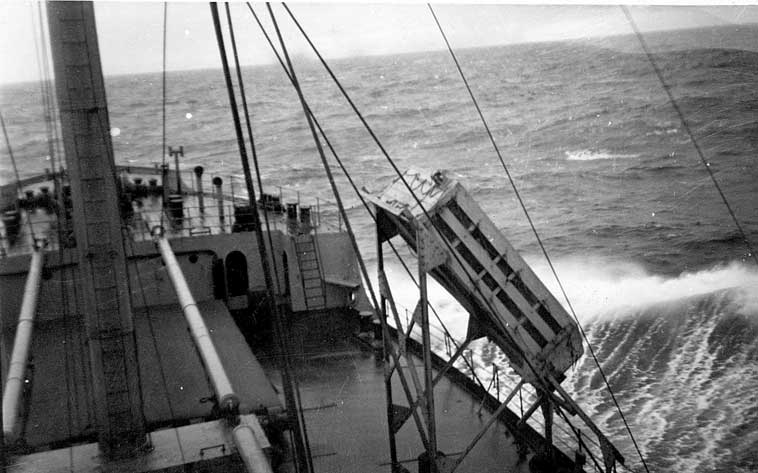
On Friday March 10, 1944, the British ship MV Tulagi left Sydney, Australia, proceeding down the New South Wales Coast, and, via the Bass Strait rounded Cape Leuwin and on into the Indian Ocean. Seventeen days later, on March 27, 1944, with a full complement of fifty-four on board (16 Europeans, 26 Indian, 7 Malay and five gunners of the Royal Australian Navy) she was torpedoed by the German Submarine U-532 commanded by Fregattenkapitan Ottoheinrich Junker of the First Monsun Group operating out of Penang, Malaysia. Of the 54 original crew members only 15 survived the torpedo attack, of which 8 were later lost.
In SRI RAMANA MAHARSHI: And The Last American Darshan in passing, I make mention of the Tulagi, especially so the lost eight and how at the exact same time that she was torpedoed, I too, as a very young boy, was onboard a ship in the Indian Ocean possibly within the same striking distance. The Tulagi is brought up because of a letter sent to my father by the woman of the couple I was traveling with, to wit:
"The
Liverpool Letter, except for several long incoherent paragraphs about picking up a live survivor or two or none at all amongst several dead in a life raft sometime before arriving or after leaving Cape Town, South Africa, circulated mostly around the logistics of bringing me home."
Although when I mentioned the Tulagi in a round about way, like I say, it was in passing, with no intention to turn it into a much larger discussion, even though it had a tendency to do so. When I throw in such tid-bits of information, for whatever reason it goads certain people to no end. The quoted sentence above, which appears at the source so cited, is one of those tid-bits and refers to the lost Tulagi eight
Why would the quote "goad" anybody? Mostly because people are always looking for kernals no matter how large or small to discredit what I have presented in the Last American Darshan. They know, for example, if something even as unimportant as the the liferaft story in the overall scheme of things can be shown to be unsound then the whole of the thesis so presented could be suspect.[1]
The letter so mentioned in the quote was written by the woman of a couple that took me, as a young boy, to India. In the letter she indicated that a liferaft was encountered in some fashion by the ship we were on during our return trip to England. How she worded it wasn't totally clear and could be deciphered, at least in how I read it, in a number of ways. It was clear in what she said that there was a liferaft, but IF the liferaft was encountered before or after Cape Town or IF there were or were not survivors was muddled, hence the reason I wrote the sentence the way I did. She didn't elaborate one way or the other or attempt to clarify the event because anything regarding the liferaft had nothing at all to do to do with the point she was trying to get across in the letter. The thing is, that tiny tid-bit sets the scene for the timing when I was in and left India.
Now, while it is true I wrote the sentence, I was really recounting for the reader what she wrote. However, that doesn't make the contents have any less import. When I wrote the whole of the paragraph including the sentence I could have easily chosen to have left it out and nobody would have been any wiser. I could have even deleted it later. Instead I chose to research down the accuracy of her observations, which, if being correct, would add additional credence to my meeting with the Bhagavan and any eventual outcome under his auspices so claimed.[2]
The foremost chronicler of my visit to India, Ramana adherent C.R. Rajamani speaking of his own visit to the ashram of the venerated Indian holy man the Bhagavan Sri Ramana Maharshi, relates that he was not certain about the date or the month he was there. He writes:
"(I)t may have been December or January. I remember the season was quite cool. The summit of the holy mountain Arunachala was shrouded in dense mist and clouds. The morning air was crisp and pleasant."
Rajamani states that the couple was in India to attend the Theosophical Society's world convention which was usually held at their world headquarters at Adyar, Madras in December-January.[3] I put the couple, with me in tow, at the Ramana ashram in the January side of things. Rajamani writes:
"Within an hour of his face-to-face meeting with Sri Bhagavan, his mental barriers were reduced to nothingness. He shed tears for quite some time and later said to his mother, 'I am so happy. I don't want to leave his presence. I want to be always with him!' His mother was most upset. She pleaded with Sri Bhagavan, 'Swami, please release my son! He is our only child. We will be miserable without him.' Sri Bhagavan smiled at her and said, 'Release him? I am not keeping him tied up. He is a mature soul. A mere spark has ignited his spiritual fire.'"
As the events at the ashram unfolded Ramana made it clear that I should go with my parents, that is, return to BE with my REAL parents, back in America, my destiny was not in India at that time. Ramana, understanding the soon to be outcome of things on a spiritual level, meant for my return to America and the rejoining with my real parents to transpire as expediant as possible --- while my mother was still alive and my father was still in control of his well being.
While at the ashram I met an anglo boy my exact same age named Adam Osborne who, if he didn't actually live at the ashram with his mother, he was there all the time with her. In later years we met again as adults in of all places, Silicon Valley where he had become a multi-quadzillionaire computer geek. During general discussion about our childhood at the ashram together he remembered us running around all over the place up even up to the point of being eye-admonished by the Maharshi. He also remembered I told him at first I did not want to go to India with the couple and fought hard not to do so. After arrival, however, he said I had a much different view. When it was time to go, I didn't want to leave.[4]
My big change of viewpoint notwithstanding, the Australian couple followed Ramana's advice and took me back to America. However, they did so at their own leisure relative to Ramana, albeit all the while looking over their shoulder with no slight amount of apprehension. In April of 1944 the Japanese had launched a three division invasion into India out of Burma and, even though the spearhead was some 1500 miles away, the couple shuddered at the outcome of such events in India as well as their own homeland. By the time I arrived home my mother had passed away with the funeral completed and over, my brothers scattered to the four winds, and my father gone.[5]
The couple, after arriving in New York and not wanting to return me to the west coast because my immediate family had disintegrated, plus I guess, possibly face any potential wrath from remaining family members that knew about the situation and or who may have misinterpreted their intentions, took it upon themselves to just dump me off unannounced at my grandmother's house on my father's side in a small little town located in the lower southeast corner of Pennsylvania --- a grandmother who I had never met in my life nor ever even heard about.
Then somehow, after being left with my grandmother on my father's side in Pennsylvania, at least as it was told to me by my uncle years later, and he didn't remember or know how or how long I was there, I was returned to California to be with my grandmother on my mother's side --- but NOT by the couple. They basically disappeared after Pennsylvania and to my knowledge never heard from again.[6]
THE TULAGI RAFT DRIFT STORY:
On the morning of Friday March 10, 1944, while I was in India, totally unrelated and unbeknownst to me or anybody involved with me or the parties I was with, the MV Tulagi, loaded with a cargo of flour and 380 bags of mail left Australia for Colombo, Ceylon (now Sri Lanka) under control and orders of the British Admiralty.
At noon Monday March 27 the Tulagi was expected to pass 300 nautical miles east of Chagos Archipelago. At about ten minutes past midnight Tuesday March 28 as she reached the position 11 degrees 00 minutes South, 78 degrees 40 minutes, East the Tulagi was attacked and struck by two torpedoes from the German submarine U-532. The Tulagi sank in 20 seconds, stern first then rolling to starboard. Only 15 crew members survived.
Those 15 survivors, using their wits and wile in the dark of the night and in the middle of the Indian Ocean, were able to lash together four rafts along with items of equipment and stores removed from a few lifeboats that broke loose as the ship sank. The rafts were open 6 x 8 x 3 feet with forty-four gallon drums as flotation devices housed in open wooden frame. The rafts could be operated from either side and 10 persons could easily fit into each raft. The 15 sailors divided into three groups of five with one group in each of three rafts with the fourth saved as a spare. During a storm the rafts began banging together so bad the spare raft was cut loose.
TYPICAL OPEN WOODEN-FRAMED LIFE RAFT USING 44 GALLON DRUMS FOR FLOTATION
(please click image)
Because so little progress was being made with three rafts lashed together, on April 21 the survivors divided into two groups, seven in one raft, eight in the other, cutting loose the the third raft. They rigged a sail on one of the rafts pulling the other. Several times the rafts broke apart and each time the crews were able to relash them. However, at about 4:00 PM Friday May 19 the lashing used to hold the two rafts together broke for the last time and the rafts drifted apart, eventually the distance widening so much they lost sight of each other.
On Tuesday May 25 at 10:00 in the morning, after allowing for leeway, currents and steering, drifting an estimated 2160 nautical miles (2485 statue miles) and 58 days after the Tulagi was torpedoed, members of one of the rafts sighted an island about five miles to the west. Two more islands were observed. They decided to make for the smallest of the islands as it was the closest. Around 11:10 PM they landed on Bijoutier, a tiny island of the Alphonse Group belonging to the Outer Islands of the Seychelles.
Ten days later, on Friday June 9 a piece of at least one the remaining three rafts was found on the island of St. Francis some 5 miles to the south of where the known survivors landed. A search revealed no evidence of the other victims or any other parts of the raft. No one knows their eventual fate. It is thought the personel on the second raft did not survive after it drifted from sight on May 19, 1944.
So, what does all of the above have to do with the letter writer's account of encountering a liferaft on the voyage from India? It has to do with what liferaft it was and where it came from. There is no doubt that both the Germans and the Allies kept fairly accurate records of sinkings of ships and submarines during the war. Those records, for the most part, unless they were secret missions, are available one way or the other to those so interested. In the case of the liferaft observed by the letter writer, the Tulagi sinking that resulted in the survivors endeavors as presented above, is the only one that meets all the necessary criteria of time, place, and location.
The problem is, IF the letter writer's ship had interacted with the liferaft and found just one live survivor, OR even brought a lifeboat of dead sailors on board at the most, or indentified the dead and left or buried them at sea at the least, it would seem that, because of the impeccable record keeping, the results of such a find would easily be obtainable. The thing is, there is no record of such an event. So, what's the answer?
Most of what has been presented regarding the fate of the Tulagi and it's crew has been garnered from the primary source for information surrounding the event: The Voyage of the Survivors of the MV Tulagi by Captain S.J. (Mick) Costelloe. In his compilation of events Costelloe writes:
"During the afternoon Thursday 30 March a ship was sighted approaching from North. She was zig zagging, the vessel was signaled with a flare, the vessel came within 2 miles and victims on the rafts felt that they had been seen and would be picked up. Others in the raft noticed another vessel approaching fast from the north and this gave them high hopes of being rescued. As the second vessel came closer it was seen to be a submarine of the non friendly type. The submarine came within 1 mile, the crew of the submarine were noted to be looking at the raft, she then dived."
In a similar sighting one month later Costelloe writes:
"On Sunday 30 April (34 days into the drift) they saw smoke from a ship on the horizon, when she was closer the raft signaled using flares. To quote John Ward again 'she came within a couple of miles of us but paid no attention to us. but they must have seen us, but went north on her zig zag course. The ship passed about 1700 hrs.'"
Even though the law of the sea would seem to indicate that when it comes to what should be done when survivors or potential survivors in liferafts are come upon, friend or foe alike, the results of such an encounter should be somehow humane in nature. In both cases above, although the survivors felt their liferaft had been "sighted," no attempt by either ship to assist was forthcoming. If they saw the liferafts and continued without helping most likely no record would be available because making record of such and event would be incriminating. Now it could be possible that one of the two ships was a ship the letter writer was on. However, when the two quoted events transpired the rafts were still lashed together and all 15 survivors were still alive. It is my opinion that the liferaft mentioned by the letter writer was the second of the two liferafts AFTER the rafts were separated, the one that was never heard from again. While it is true that on Friday June 9 a piece of one the other three rafts was found on the island of St. Francis some 5 miles to the south of where the known survivors landed, it does not mean the wreckage was from the second raft. That second raft could have continued on missing the islands all together only to be sighted later by the ship the letter writer was on. Again, if the liferaft was sighted and no matter how close they came BUT continued without helping or interacting, even if all aboard the raft were determined to be dead, most likely no record would be available because making record of such and event would be, as I have said, incriminating. It should be mentioned that in the first quote above a submarine of a non-friendly type was observed. Sometimes submarine commanders would use liferafts as a lure to get an unsuspecting vessel within effective torpedo range. It could be during an attempted rescue, before the ship could act, it was scared off --- however to cite such a scenario a known submarine would have to had been in the area, and there was no attempt by a submarine attacking the letter writer's ship noted in any of her writings --- an event that one would surely think would have been recorded. When I say no attempt by a submarine attacking the letter writer's ship I mean of course no visual sighting of torpedoes being unleashed toward the letter writer's ship was reported by her or anybody else. It does not mean the ship the two of us were on had not come under the direct observation of the periscopes from any number of prowling U-boats or submarines. Why no attempted attack transpired is still unbelievable to this day.[7]
In the first few years of the war the Indian Ocean was pretty much a forgotten backwash. The Germans had the Atlantic covered and the Japanese basically had all of the Pacific as their stomping grounds. However, as hostilities continued and the allies became better at sub hunting and the convoys became more and more secure and difficult to penetrate, the Germans and Japanese were squeezed into the much safer (for them) Indian Ocean. Hence, by 1944, the same period of time the ship I was on was crossing the Indian Ocean, greater numbers of both Japanese and German submarines relatively speaking were prowling in the same general area, often overlapping and not always with coordinated efforts. However, if one didn't get you the other would. As the sinking of the Tulagi makes clear, the Indian Ocean during that period was an extremely dangerous place for merchant and passenger vessels --- with the Tulgai going down in 20 seconds. I have no idea how many times the ship I was on came into the periscope crosshairs of a German U-boat or Japanese submarine. However, the whole route of travel from India, around Africa and into the Atlantic on to England was crawling with submarines, every one seeking an easy, vulnerable target. Looking back it must have been pure luck, fate or karma. Throughout the years I have come to appreciate the results, which has in turn established in me a strong interest in how the actions and/or selected non-interactions of submarines and their operations, Japanese or German alike, have impacted the outcome of my life.[8] [9]
(for larger size click image then click again)
U-532
Interestingly enough, the U-532, the same German submarine that sank the Tulagi, at the end of the war surrendered under the same commander and crew, ending up in Loch Eriboll in Scotland on May 10, 1945, one year to the day that the ship I was on had been in the Indian Ocean on its way to Liverpool from India, then on to the United States.
Before moving on I would like to make mention of a small but rather vocal faction of people who have a own bone to pick with what I have suggested regarding Tulagi survivors: historians and relatives of crew members. For those who may be so interested please visit Footnote [10].
M.V. TULAGI: SINKING OF BY JAPANESE SUBMARINE
SIXTEEN PAGE DOCUMENT FROM NATIONAL ARCHIVES OF AUSTRALIA, NAA: B6121, 155A
AUSTRALIAN MERCHANT NAVY: MV TULAGI
GERMAN SUBMARINE U-532
CODE TALKERS
SHIPWRECKED SAILOR
THE JAPANESE SECRET WAR
WORLD WAR II COMES TO REDONDO
I-9 SINKING OF THE SS LEWIS CASS
WW II PLOT TO UNLEASH BUBONIC PLAGUE AGAINST LOS ANGELES
GERMAN SUBMARINE ATTACK ON HOOVER DAM
THE STRANGE ODYSSEY OF THE GERMAN U-BOAT U-196
THE ULTIMATE IN SHIPWRECKED SAILORS:
VIKINGS OF THE DESERT SOUTHWEST: THE LOST VIKING SHIP
RALPH A. MULTER
GUNNER'S MATE 3rd CLASS, U.S. NAVY
CLICK
HERE FOR
ENLIGHTENMENT
ON THE RAZOR'S
EDGE
THE WANDERLING
(please click)
Footnote [1]
With the ever widening popularity of the venerated Indian holy man, the Bhagavan Sri Ramana Maharshi, especially among those from the west who were more apt to return to their home countries with stories to tell, along with the good came an ever increasing outflow of disinformation.
Although Ramana himself was unconcerned, having no real interest in such things one way or the other, a growing cadre of inner circle protectorates began ensuring the flow of informaton met their view of how the Maharshi should be preceived --- thus, in effect, creating a semi-power base that could if they were to so chose, the ability to discern who was or was not an "aceptable" follower, devotee, or disciple by supporting or advocating or eliminating or deleting whomever they so chose. For further clarification, please see Footnote [2] as well as:
SRI RAMANA'S WESTERN DISCIPLES
ENLIGHTENED INDIVIDUALS I'VE MET
Footnote [2]
As I have expressed above, I throw in tiny tid-bits of information here or there that for whatever reason seems to goad certain people to no end. In the Last American Darshan, the mention of the letters, then proving their validity --- say like with the lifeboat situation --- just seems to get to certain people. The question is why?
It has to do with how protective keepers of the Ramana flame can be. Take for example the highly respected and very pro-Ramana author David Godman who put together a small book about Annamalai Swami. The Swami was a former Ramana attendant and confidant that had Awakened to the Absolute through the grace and light of the Maharshi. The book contained transcripts of actual conversations between Annamalai and various seekers he met with at his ashram during the final months of his life. In it Godman included a few comments that came up regarding Sri Ramana's younger brother, Nagasundaram --- popularly known as Chinnaswami (the Younger Swami). The people at Ramana Ashram insisted the parts of the book related to Chinnaswami be expunged. Annamalai Swami agreed to a few of their requests but refused to delete others.
As to the Last American Darshan a good portion of the contents therein circulate around a talk C.R. Rajamani presented to the April 25, 1998 Aradhana program at Arunachala Ashrama in New York. Rajamani offers his observation that a boy he saw with a couple in the meditation hall at the Ramana ashram in the early-mid 1940s, being white, was a foreigner --- which on its own would not be too difficult to discern. However, he runs afoul in his designation as to the boy being of Australian descent. From the couple's accent Rajamani may have subjectively tagged the two of them as being from Australia, which they were --- at least the man of the couple --- and thus then, assumed the boy (i.e., me) was too.
However, although any number of people have grabbed on to that, such was not the case. Rajamani was not an interview reporter. He was a Ramana adherent visiting and meditating in the ashram who presented through his writings what he saw through personal observations --- most probably garnered from a distant and written sometime after the fact. Please note by going to the Rajamani page that he starts out right away saying he was at the ashram in his early twenties and that he had been a devotee of Sri Ramana for over 55 years. He also says, in relation to the event that transpired between the Maharshi and the young boy, that the event was "still fresh in (his) memory." The conclusion to be drawn from such comments is that the contents of his article were NOT written on the scene in the 1940s, but possibly recalled some fifty or sixty years later specifically for the year 1998 Aradhana program. Please note on the page as well Rajamani's speculative use and emphasis on "PRESUMABLY the boy's father" and "I THOUGHT she was the boy's mother." Presumed and thought, not knew.
In an update to the Rajamani article, the most respected Professor Laxmi Narain, who compiled and edited the book entitled "Face to Face with Sri Ramana Maharshi, Enchanting and Uplifting Reminiscences of 160 persons" (Sri Ramana Kendram, 2005), has revised and updated his book by including an additional forty face-to-face meetings with Ramana.
Rajamani's paper is now included as one of the additional forty face-to-face meetings with Ramana. It should be pointed out that the main point I cite and reference in my works as being inaccurate in Rajamani's presentation --- i.e., the boy's nationality --- has been mysteriously deleted and/or removed from the text, and done so most notably since the appearance of the Last American Darshan.
You can see for yourself the aforemention deletion or correction, as the case may be, in "real life" by going to the PDF online version of Laxmi Narain's book. Refer to Number 179, page 384, titled C.R. Rajamani:
FACE TO FACE WITH SRI RAMANA MAHARSHI
Enchanting and Uplifting Reminiscences of 202 Persons
SRI RAMANA MAHARSHI: THE LAST AMERICAN DARSHAN
RECOUNTING A YOUNG BOY'S NEARLY INSTANT TRANSFORMATION INTO THE ABSOLUTE DURING HIS ONLY DARSHAN WITH THE MAHARSHI
Footnote [3]
That would be the 67th International Convention held December 26 to 31, 1943 at the International Headquarters, Adyar, India.SEE
In a further confirmation of the timeframe Rajamani writes:
"It was in the original small hall, that is remembered by the early devotees with justifiable fondness, that I first saw Sri Bhagavan seated on a raised platform."
According to SRI RAMANA MAHARSHI: Timeline, although there was some minor preliminary work on the eventual location of the big hall (i.e., the New Hall) such as clearing ground, moving rocks, etc. done earlier, actual construction such as laying of the foundation and that sort of thing did not occur until January 25, 1945, with the cornerstone not being laid until June 5, 1945. It wasn't until four years later, on March 14, 1949, that Ramana was taken to open the New Hall. So, for the most part, to set the timeframe during the time period we are talking about here, that is Rajamani's visit to the ashram, prior to the end of the year 1944 ONLY the small hall, or Old Hall as it came to be called, existed.
For more on the Old Hall and the timing of the construction of the New Hall as viewed through a completely different prism, most notedly as provided through that of the warped time of the mysterious hermitage of Shambhala hidden high in Himalayas, please see:
MAP AND HISTORY OF THE RAMANA ASHRAM
THE CODE MAKER, THE ZEN MAKER
SHANGRI-LA, SHAMBHALA, GYANGANJ, BUDDHISM AND ZEN
THE WAY TO SHAMBHALA
MOLLIFYING THE NAYSAYERS
Footnote [4]
Adam Osborne basically lived at the ashram from a toddler through to age 11 for a total of about eight years. When he and I first met he had only been at the ashram a short time, having shown up in Tiruvannamalai with his mother Lucia Osborne together with his two sisters while on vacation in India from Thailand, staying because of the seriousness of Japanese occupation reported there. So said, although by age 11 he may have accumulated a lot of toys and stuff, at the time the two of us first met, for the most part, he didn't have any real toys to speak of --- at least no more than any kid on vacation for a short time would expect to have with him while traveling --- plus, it was at the height of the war and nobody really had any toys, especially new ones.
During one of our meetings as adults he brought up the most obscure fact I could ever think of. He said he remembered while we were kids at the ashram, amongst what few things I had with me was what he called a code maker thing that looked all the same as a badge.
What he was referring to was a Captain Midnight Code-O-Graph that as a young boy at the time I carried around with me everywhere I went. In that, because for both of us our situations for being in India was such that it was not specifically within our control, neither of us really had anything like toys or anything similar typical kids our age might have so to speak. The Code-O-Graph was a huge exception to that aspect of our lives. He said he remembered it fondly because the badge sort of connected him back to a normal childhood in a sense. When I told him after all the years I still had the same decoder he could hardly believe it.
The next time we met I brought the decoder with me and it was easy to see when he held the badge it sent him back to another time, his eyes even filling with tears. Handing the Code-O-Graph back he said that he was certain he remembered the badge as having instead of a photograph of Captain Midnight, a photograph of me, looking all the same as he did when we were both kids --- although truth be told, even though the badge was a Captain Midnight decoder I don't think Osborne had any idea as to who the man in the photograph was, i.e., Captain Midnight, simply calling him I believe, a "pilot," because of the aviator's helmet and goggles he had on.
One day when my younger brother saw the Code-O-Graph for the first time in many years, he too, as he held it, could easily see there was a picture of Captain Midnight in the square. He mentioned he was sure he remembered it as having a photo of me as a boy instead a picture of Captain Midnight in the square. With me not pursuing or expanding the conversation beyond a mere silent lack of agreement face gesture and shrugging of the shoulders, he moved on, apparently brushing it off as not much more than a faulty memory on his part or some such thing. The quote below, from The Code Maker, The Zen Maker so linked, in a sort of Mobius Strip sort of way discusses the switch:
"The boy, seemingly intrigued and perplexed that my badge would have a picture of him in it, waffled when I told him I was sure it would be Captain Midnight's intention for my photo badge to be his and that we should trade. I could tell that he, in a young boy's own way, was considering my suggestion as having some merit, but in the end he was steadfast in not wanting to trade HIS decoder for mine or anything else for that matter, especially since his had more of a brand new sheen about it while mine seemed somewhat dull and worn. For some reason bigger than me, I was being compelled, almost driven, to persuade him to do otherwise. After a short discussion and with his permission, I carefully removed the photo out of the decoder I had and put it in the boy's, then put the picture of Captain Midnight into mine. With that, all excited and seemingly pleased with the results, he ran off across the compound as if to show somebody."
TIME TRAVEL: MEETING YOURSELF
Footnote [5]
Adam Osborne, the person mentioned previously I met as a boy at the ashram, and who I met as an adult, shared what we could remember from that part of our childhood. The following is from some of that sharing and sheds light on the timing of my stay at the ashram:
"He also told me we had participated in Giri Valam, circumambulation of the holy hill Arunachala, although he did not recall if we completed the walk or who we went with. Neither too, did he remember if the two of us ever climbed to the top or visited the caves."
Osborne and I kept in contact with each other on and off a little bit for a few years following our meeting. Interestingly enough during one of those short lived contacts, out of the blue, he brought up Giri Valam, circumambulation of the holy hill Arunachala and how it related to the two of us. Osborne's father had died in 1970 and Osborne told me that sometime prior to his father's death a man by the name of William Samuel had contacted him in the U.S. and expressed an interest in meeting his father. In their conversation Samuel told him that he and Osborne (the younger) had met at Ramana's ashram in India in 1944 and that during his stay, on the full moon of which he thought was April of that year, he, Osborne and another young boy and a few other people including his mother Lucia Osborne, circumabulated Arunachala. Osborne emphasized the younger boy aspect with me specifically because Samuel thought, Osborne guessed, that the other boy (me) was his brother --- a twin brother --- because of our age, size, body build and look-alike curly haired mop tops.
SAMUEL THOUGHT ADAM, ABOVE LEFT, AND I WERE
TWINS BECAUSE OF OUR CURLY-HAIRED MOP TOPS
At the same time Samuel was at the ashram, 1500 miles east across the sub-continent edging up along the Burmese border the Japanese launched a three divison invasion into India. Quickly outstretching their supply lines and hoping to replenish their local needs by overtaking British, American and Indian garrisons, etc. while their lifelines caught up, didn't happen. For the most part, three months later, met by stronger than expected Allied response and caught in the monsoons, the Japanese were forced into retreat dying of malaria and starving to death --- in the end losing over 80,000 men.
JAPANESE INVASION OF INDIA
DURING WORLD WAR II
In the early stages of that invasion William Samuel, a 21 year old captain in the U.S. Army and a veteran of three years fighting with the Chinese Nationalist army against the Japanese in China was apparently called over to the India side of things and somehow must have finagled some much needed R and R, ending up at the Ramana ashram for a week or so in April. By the end of the war he was back and well entrenched in China fighting along side the Chinese troops retaking Ishan, Liuchow and Kweilin. Interestingly enough, ten years later, after being called back into the army for the Korean war Samuel had what was nothing less than an Enlightenment experience.
Below are two sentences as they appear in the closing paragraphs of the The Code Maker, The Zen Maker, so linked, that are closely related to how William Samuel played a significant role at the ashram and the even bigger part he played in the outcome of events and how they related to me specifically:
"I scooted as quickly as I could across what was left of the ashram grounds between me and the gate and out onto the street, melding into the small milieu of what counted as crowds in those days, disappearing.
"Years passed and one day a friend of mine helping me go through a few things ran across my rather loose knit so-called collection of decoders that were sort of doing not much more than just floating around in an unconnected fashion in a drawer."
Although the physical visual-space between the two sentences that separates them is small, the gap between the two related to the passage of time within the context of the sentences is huge. One moment, when all the trials and tribulations that have been laid out from childhood through to the Army, the monastery, the Himalayas, et al have ended, I walk away from the ashram, suddenly jumping to many years later, apparently comfortably safe back at home in the United States as though nothing ever happened --- simply hanging with a friend sorting through a bunch of decades-old Captain Midnight decoders.
Most people who have read through all that I've presented in The Code Maker, The Zen Maker, with the seeming thousands of interlinking footnotes and all, have had enough. However, every once in awhile there are those who come forward interested in the jump between the two paragraphs and how it was closed. Let me just say, in more ways than one, it involved war torn Burma, the Japanese invasion of India, the crash of a C-47 high in the rarefied air in the Tibetan area of the Himalayas after being lost on a flight from Calcutta, and William Samuel and his visit to the Ramana ashram at the same time I was there.
RETURN TO THE MONASTERY
BEFORE LEAVING CALCUTTA-----------------------------------------------------AFTER LEAVING CALCUTTA -----

WILLIAM SAMUEL: A SOLDIER'S STORY
TERRY'S P-40 FIGHTS ZEROS ATTACKING CNAC C-47
(please click image)
GIRI VALAM
Footnote [6]
(photo courtesy Arizona Republic)
It was during my return trip to my grandmother's in California that another interesting aspect to my young life unfolded. When my uncle was verbally addressing my return to California from Pennsylvania, saying he 'didn't remember how long it took,' he was referring to the stretch of time that elapsed between my actual arrival in Pennsylvania and when I left, my uncle not knowing when or how I really ended up there. Afterwards, because of a known event, one could have been able extrapolate almost down to the minute, the exact day, date, and time I left, thus then, approximating a near exact time I showed up to stay with my grandmother on my mother's side, except for that too the specifics got smeared.
The event? Sometime near the very last day of June or so 1944, I was put on a passenger train somewhere in Pennsylvania headed toward Chicago, traveling with who I do not know. If it was or was not the couple who took me to India has never been confirmed. In Chicago I boarded the Number 19 Santa Fe Chief westbound to Los Angeles. Toward midnight of July 3, 1944, between Flagstaff, Arizona and Williams, on a high speed downhill run and behind schedule, the Chief's locomotive, a powerful Baldwin built 4-8-4 Northern with 80 inch drive wheels and clocking out at over 90 miles per hour, hit a marked 55 mph speed limit curve, with the locomotive derailing and sliding in the dirt on it's side off the tracks for well over 500 feet before coming to a stop. The rest of the 14 car train ended up in various stages of derailment and wreckage on and off the track, some cars remaining upright with two actually staying on the tracks undamaged. The fireman and three passengers were killed. 113 passengers along with 13 train employees injured, among them the severely injured engineer.
WRECK OF THE NUMBER 19 SANTA FE CHIEF JULY 3, 1944.
(photo from Chris Baird Collection)
Although I was unhurt, the person or people I was traveling with was among the injured and taken, with me along with them, to either Williams or Flagstaff. Because of the nature of their injuries, whoever I was traveling with was held-up under doctors care for several days, leaving me without direct adult supervision. My grandmother, who had been contacted by the railroad, called my uncle in Santa Fe. He inturn contacted a nearby tribal spiritual elder to oversee me until someone was with was able to get me to the Los Angeles Union Station and thus then, my grandmother's home in California.
The events found in this footnote has also been presented by me in virtually the same manner and same form in any number of my other works. What I have not included in the above account or have not revealed previously is a part of the crash event that circulates around the somewhat mysterious tribal spiritual elder my uncle arranged for me to be watched by until he, my uncle, could catch up with me. As you may recall, after the wreck, because the adult or adults I was traveling with had been hospitalized, I was left without adult supervision. I write about sitting in the waiting room of some train station in Arizona with the tribal spiritual elder late at night until my uncle was personally able to intercede and safely get me to Los Angeles Union Station and thus then, to my grandmother's home in California.
What I don't write about is that I recognized the spiritual elder the moment he walked into the hospital waiting area looking for me as found in the following quote:
"Mid-evening on the night of the-unknown-to-anybody at the time up-coming crash I had gone to bed in the bunk in my compartment and as far as I knew had fallen fast asleep. Sometime during that period between the time I fell asleep and the crash occurred I found myself neither asleep nor in my bunk but outside of the train standing barefoot on the desert floor in the middle of the night in my PJs some distance off from a set of railroad tracks, my hand being held by an elderly Native American man."
THE SPIRITUAL ELDER AND THE SANTA FE CHIEF
Three years later, within a day or two of the third year anniversary of the train wreck, July 3, 1947, found me with my uncle traveling in the desert southwest having passed through Williams, Arizona on our way to Fort Sumner, New Mexico to visit the gravesite of Billy the Kid. We stopped at the crash site to pay reverence to those that died and my survival. While my uncle sat in the truck I walked the tracks where the wreck occurred. In the three short years since the derailment barely a sign of anything having happened remained, the wind along with the heavy downfall of summer monsoons nearly erasing the 500 foot groove and other marks caused by the huge Baldwin locomotive and passenger cars. If a person was unfamiliar with what happened it would have been unobservable.
After paying my respects at the crash site --- and my uncle and I headed toward Fort Sumner --- the Fourth of July weekend of 1947 was upon us. Any deep reverence or importance by me being at the train site was quickly overshadowed by a much larger event of earthshaking and monumental status when in the middle of the night of that weekend an unidentified airborne object of unknown origin began disintegrating, spreading debris and foil in a long swath out over the New Mexico flatlands only to eventually slam into the northern face boulders and rocks of the lower upslope of the Capitan Mountains --- an event that soon became known worldwide as:
THE ROSWELL UFO ----
UFO CRASH SITE STUMBLED UPON BY ARCHAEOLOGISTS, CAPITAN MOUNTAINS
(please click either image)
ACCIDENT REPORT: SANTA FE CHIEF JULY 3, 1944
SANTA FE LOCOMOTIVE #3774
RIDING THE CAB FORWARDS
SUPERBOY TRAVELS BACK IN TIME, ENDING
IN REAL LIFE ANALOGIES IN TIME AND PLACE
(please click image)
Footnote [7]
It should be noted that in researching where the liferaft seen by the letter writer could have orginated, the name of the ship, Tulagi --- although an unusual name or word, and surely not in everybody's everyday vocabulary --- was not the first time I came across it. In an incredible coincidence the "word" Tulagi came up in conversation years before I ever even heard of the liferaft situation.
If you recall from the main text above, after returning from India and being left unannounced with my grandmother on my father's side in Pennsylvania for an unknown period of time, at least as my Uncle related it to me, I was returned to California to be with my grandmother on my mother's side. I was with her only a short time when I was fostered out to a couple that owned a flower shop. After awhile, not liking the arrangements for one reason or the other, I ran away from home without anybody knowing where I was or having anybody's consent to do so. I ended up staying with a recently discharged World War II ex-Marine taxi driver that had fought his way up through all the islands in all the major battles in the Pacific from Guadacanal northward.
Instead of going to school I would hang out in his taxi with him. Several days a week we would end up having breakfast at the Happy Hour Cafe owned by the infamous Fifie Malouf. Sometimes in the afternoons or evenings I would hang out in the cafe while the ex-marine "visited a friend" in one of the apartments attached to or nearby the cafe. As a young boy basically left unattended in the cafe every now and then, it wasn't long before some of the women who were associated with Fifie in some fashion, and who joined us for breakfast once in awhile or bought me a malt or a coke in the afternoon, befriended me.
I was sitting in the cafe with a couple of the women and the ex-marine taxi driver when another ex-marine who apparently knew one of the women, stepped up to our booth and invited himself to join us. It wasn't long before the two former marines discovered they both had been on Guadacanal and in the process began to dominate the once shared conversation with nothing but war stories. That is, until the self invited ex-marine interjected a story about an unusual situation he observed. In August 1942 he was on Tulagi Island, a short distance southwest of Guadalcanal when he and a bunch of other marines observed some sort of flying objects that were different than anything he had ever seen. He said they were round and nearly flat, shaped almost like an upside down pie plate tin, with no wings or fuselage, glistening with a silver sheen. With that one of the women butted in and told the ex-marine that was nothing because one night in February 1942 right there on the Strand a huge, giant object, as big as a locomotive, came in off the ocean and flew right over the top of the Happy Hour Cafe and the apartments. She had heard a ruckus going on outside, sirens, guns firing, all kinds of stuff, so she went out on to the Strand only to see this "thing" a few hundred feet above the beach slowly glide overhead off the ocean, not making a sound and, because of its length, taking forever to pass over. The two ex-marines just looked at each other and went back to telling their war stories. I knew the event she was talking about because I had seen the object myself. Not only did it apparently fly over the Happy Hour Cafe, it flew right over the top of my house as well. The object and the event, which was seen by thousands and survived over 1440 direct hits by anti-aircraft rounds before disappearing out over the Pacific someplace west of San Diego, has become known as The Battle of Los Angeles: 1942 UFO.
MY MERCHANT MARINE FRIEND
P-40 WARHAWK
PEARL HARBOR SURVIVOR
FOO FIGHTERS
Footnote [8]
I personally know first hand of a ship that sailed across the Atlantic into the Indian Ocean to Calcutta totally unhindered without incident at the exact time we are talking about here, 1944. It was however, not a passenger ship, but a Liberty ship sailing as a part or a convoy, which is a totally different proposition than a lone passenger ship crossing those same open seas.
I became aware of the ship during my first two years of high school because I worked a couple of afternoons a week and on the weekends running errands for a person I usually refer to in my writings as my Merchant Marine Friend. He was basically house-bound after having been badly burned when the ship he was on during the early days of World War II was torpedoed by a German submarine. To save his own life, as the ship was sinking, he had to jump overboard, landing in a sea of burning oil and naphtha, the ship's escaping now on fire onetime cargo. Because of the attack and the resulting injuries he was hooked up to some sort of breathing apparatus attached to an oxygen tank, plus, on-and-off throughout the day he had IVs stuck into his arms and wires attached in various places for monitoring equipment to record his heart rate, blood pressure and other vitals. So said, for the most part, because he was so hooked up to machines and couldn't move he basically just sat there all day long in a den-like room overlooking the street reading books, newspapers and staring out the window.
People from all over would come over to visit him on a regular basis, usually active duty or former merchant marines. One that did on one of the days I was there was a man named Bob Kaufman.I remember Kaufman specifically because he made a big fuss over a somewhat unique gold necklace my merchant marine friend was wearing. Kaufman told him that some ten years before, during the early part of 1944, with the war still raging, he had sailed out of Philadelphia on board a Liberty ship headed toward India, ending up in Calcutta. He was stuck there for about a month before being shipped out, sometime he thought, around the middle of May, 1944, albeit on a completely different ship than he came in on, called the S.S. Harold L. Winslow.
Kaufman said he had arrived in Calcutta on the S.S. James E. Eads, but missed shipping out because of a toothache. However, even before the toothache and the Eads leaving he said a man around 25 years old claiming he was an American soldier, although dressed in civilian clothes, came to the ship looking for him. The man that claimed to be a soldier told him he knew that he, Kaufman, would be arriving in Calcutta on board the Ead. Kaufman also said the soldier told him that the two of them had a mutual friend, another merchant marine, which just happened to be the same merchant marine he was visiting. Since Kaufman missed his ship and was stuck in Calcutta for who knew how long, he and the soldier, who he said, was waiting for a CNAC flight out over the "hump" to China, got together several times. It was during one of those times Kaufman first noticed a necklace the soldier was wearing and during one of those times he asked to see it, examining it very closely. He said, even though many years has passed since he had been in Calcutta and seen the necklace, it was so unique that there was no doubt that the one he saw that the soldier had and the one that he, the merchant marine was wearing, were exactly the same if not one and the same.
Notice the months and years Kaufman was sailing across the Atlantic and in the Indian Ocean was the same time the M.V. Tulagi as well as myself were sailing in the same seas. Bob Kaufman, by the way, turned out to be the same Bob Kaufman that became a major mover and poet in the 1950's Beat Generation usually heralded as being led by Allen Ginsberg, who as it turned out, had also been a merchant marine. See:
THE NECKLACE
UNDER THE PROTECTION OF
THE LORD BUDDHA
ALLEN GINSBERG
Footnote [9]
As to the hotbed of activity increasing in the Indian Ocean as the war wore on, it continued to do so right up to the end, with 1944 being a big year with lots of very important submarine goings on, goings on in some cases that if carried out successfully, could have altered the course of the war.
Because of how dangerous it had become for German surface vessels in the Atlantic and elsewhere and the ever increasing need for strategic war materials, Germany began shifting a lot of their undersea efforts to creating a fleet of cargo carrying transport subs. On August 20, 1944 and August 23, 1944, a pair of German transport subs, the U-195 and U-219 respectively, left the pens in occupied France for Japan. Part way into their travels they were redirected to the German submarine pens in Jakarta, Indonesia for unknown reasons. The top secret cargo carried by the two transport U-boats were said to be the parts of 12 dismantled V-2 rockets intended for the Japanese military along with uranium oxide requested for Japan's atomic bomb project.
According to records, sometime in early November, 1944, a third submarine, the U-181, once a proud wolf pack sub operating out of Penang, Malaysia, but reconfigured into a transport sub, lingered for days in the Indian Ocean basically in the same spot without really going anywhere. Then on November 14-15 she rendezvoused with the U-195 and U-219. Both boats, which had been traveling almost connected at the hips since leaving France, apparently continued on to the sub pens after the rendezvous --- except for one thing. Where previously they had been traveling almost side-by-side the whole of their trip, or at least one in front of the other and both should have left the U-181 at the exact same time, the U-219 pulled into base on December 11, 1944 with the U-195 not arriving until a full 17 days later on December 28th. Reports are that the U-195 shadowed the U-181 part way toward the Pacific before turning around to base. It wasn't until January 6, 1945, that the U-181 suddenly showed up back at the Monsun base, and except for needed ballast, no cargo.
After the U-195 left the U-181 just about to enter the Pacific she headed toward her new base in Jakarta. The U-181 continued on somewhere into the mid South Pacific to meet up with the mysterious Japanese Ghost Submarine I-12. After the meeting the huge aircraft equipped I-12 crossed the ocean eastward ending up off the coast of Mexico entering the La Palma Secret Base in Chiapas, only to meet her eventual fate three months later in March of 1945 off San Francisco. What all those goings on had to do with anything is not fully known. However, the results of those goings on and how they related to their initial cargo IS known --- and that is, the Japanese had not used any V-2s nor had they any in operable condition in their arsenal by the time the war ended. The same is true of nuclear weapons.
One of the most interesting of the submarine stories circulated around the U-196. On March 16, 1944 the U-196 slipped out of the German submarine pens in France into the Atlantic under orders for Penang, Malaysia. By early July she had passed east of Cape Town South Africa into the Indian Ocean arriving at the Malaysia base August 10, 1944. Approximately three months after arrival in Malaysia she left on a patrol around Australia. No sooner had she departed than she disappeared. When she failed to respond to repeated transmissions requesting her position sometime around December 1st, she was listed as missing in the Sunda Straits south of Java, effective December 12, 1944. According to legend, not long after being stricken from the records than she showed up at the La Palma Secret Base in Chiapas, then Sonora, Mexico in the Gulf of California, only to be seen off the coast of Chile, South America, eventually ending up scuttled by the crew off New Zealand. The crew, along with several high ranking Nazis and German VIPs, had turned rogue escaping with a whole cargo hold full of Nazi gold, with some of it said to have been buried in Arizona.
TWO-MAN JAPANESE- MIDGET SUBMARINE MOUNTED
ADJACENT TO THE MOTHER SHIP'S CONNING TOWER
(please click image)
Footnote [10]
As I have stated, the letter that refers to the liferaft is not totally clear in what is presented and is as well, devoid of specific facts --- facts that could or would have been helpful in narrowing down the the sighting, inturn relating it exclusively with the Tulagi survivors. As to the ship I was on there is no ship name, departure date or arrival date. There is nothing said about it being a passenger ship only or a freighter carrying passengers. We can however, from general information create a route. The ship most likely left Bombay, India traveling to Cape Town, South Africa then to Liverpool, England (one of the letters was postmarked from Liverpool). Although nothing is said about the possibility of changing to another ship in Cape Town, then proceeding to Liverpool, it could have been done, with the original ship from Bombay continuing on to North America, South America or the Caribbean. If such was the case and the ship was hit crossing the Atlantic and sunk, and there were a number of vessels that could fit the bill during the time frame we are talking about here, then any official records of a sighting of a liferaft with a number of dead --- and their names --- would have gone down with the ship. It should be mentioned, although I did not bring it up in the Last American Darshan, that the letter did make reference to the South African port of Durban. It may be that the ship made it's main South African port of call at Durban rather than Cape Town, simply bypassing Cape Town on the way to Liverpool.
There are two online discussion forums, Ships Nostalgia and the no longer active Mercantile Marine, that have in the past sort-of ongoing threads on the Tulagi. On both of them, one Prudence by name, seems to have a fairly good hook on the events surrounding the sinking and the drift, as well as being well received and respected by members of both lists. Prudence offers the following regarding the fate of the second lifeboat, albeit each with a somewhat different ending. The first would not meet my scenario, the second would. The question would be how would anybody know of the events of the first one, and of the second one, why did the survivors not come forward or ever show up anywhere?
"The story my mother was told was that the second raft came to a reef...They were all too weak to get over it into the lagoon and the sharks ate them...my mother had a breakdown and I have nightmares."
"There were survivors of the sinking who endured an epic voyage through gales with little food which ran out as did the water.. At first there were 15 who survived the sinking and these were divided onto two rafts. The personel on the second raft did not survive and drifted from sight on 19th May 1944. No one knows their eventual fate from the three surviving Burns Philip Officer's accounts. Searches of the Seychelles and the Chagos were conducted and some thought they may have eventually got to Madagascar."
Although Prudence receives no flack for either of her suggestions, there are those that have made it clear that they take more than a passing issue with mine. I would like to hear more regarding the "some thought they may have eventually got to Madagascar" part of the equation and who those some are and how they came to such a conclusion. It is quite possible that the second raft did indeed get as far as Madagascar, albeit without living survivors, ending up on some forelorn rocky beach only to battered to pieces by the sea leaving no traces of man nor wood. It is my belief that during the transit to that eventual fate the ship the letter writer was on came across the raft. Again, for more in depth and updated information, if you haven't done so already, please see:
THE LIVERPOOL LETTER
AND NOW THIS:
It should be noted that the original page I linked to and cited in relation to several quotes in the above main text, The Voyage of the Survivors of the MV Tulagi by Captain S.J. (Mick) Costelloe, found on the internet in the past most notably under a URL provided through the auspices of Mercantile Marine dot Org, is no longer active, thus then, rendering the original source for my quotes unavailable.
A new MV Tulagi page has recently surfaced on the net using as source material, as I did for my paper as well, much of Costelloe's works --- including it would seem, some of the same quotes I referred my readers to. The new Tulagi page and contents seem very accurate in their presentation, well done, and their pages reek of quality, aspects I admire in works I choose to cite. So said, the new page is what I now cite back to, if for nothing else, a second opinion, backing up what I have to say from another view, and offering additional insights into the plight of those that went down and survived the attack on the MV Tulagi.
It should be said, however, it is not a shared view. Neither in the content of their works nor in their links section is there any mention of my page, me, or the connection made by me with the MV Tulagi --- most likely a chopped liver thing.(see)
Although I don't get into it in the main text above, nor as well in the Liverpool Letter, there is some rather substantial information regarding the life raft itself the woman reported seeing that I have, except in another footnote somewhere, really not delved into.
While it is true the woman was far from clear regarding any survivors alive or dead or none at all in the letter she wrote to my dad, she did mention the raft itself --- slightly. Because of what she mentioned didn't really add up relative to anything I knew or was familiar with at the time I pretty much passed on it. The thing is, her description of what she said she saw and what I sluffed off, turned out to be closer to reality than not. She said what other passengers were claiming to be a life raft, to her, from the distance she saw it, it looked more like a bunch of barrels stuffed together in huge wooden orange crate than anything else. When I read the letter and tried to picture what she was talking about, the first thing that popped into my mind was a couple of model wooden trains I put together and painted from two kits when I was a kid.
One model was a train called the Dewitt Clinton and the other was the William Galloway, both early steam locomotives and both, to carry water, had little wooden barrels stacked into gondola cars behind the coal car. The rafts on the Tulagi, as pictured below and of which I only learned of many years after reading the woman's letter, were open 6 x 8 x 3 feet with forty-four gallon drums as flotation devices housed in open wooden frame. The rafts could be operated from either side and 10 persons could easily fit into each raft. If you compare the two graphics below you might get an idea why the wooden models from my childhood popped into my head.
-----
THE LIVERPOOL LETTER