AND THE WANDERLING'S FATHER
Alfred Robert Pulyan was a man of great spiritual prowess, an "American Zen Master" without the Zen nor the Buddhism. Because of the reputation as to his insight and the unusual home-spun nature of the level of his Attaiment his reputation continued to grow basically at a grassroots level with no pushing on his part. Before long, and well before I crossed paths with him at his compound in 1965, he had put into place what I would call a fairly well established mail order following. Pulyan claimed to have a 70% success rate, more than ten times higher than the ancient Zen masters, although none of them have ever come forward that I am aware of.
The letters related to Pulyan in the Wheaton College Archives are part of the Marion E. Wade Center Repository as found in the collection of William Lindsay Gresham, the author so mentioned in the quote below and correspondence with Pulyan, starting in 1957, ending in Gresham's death by suicide in 1962.
William Lindsay Gresham and my father were friends and drinking buddies. They came to know each other under the auspices of 20th Century Fox and the fact that my father was a onetime side show carny and roustabout. His sideshow roustabout background and midway knowledge was strong enough that studio big shots put he and Gresham together in conjunction with the making of the 1947 movie Nightmare Alley, based on Gresham's strong carnival themed novel of the same name.
Gresham's was a heavy drinker, something my dad could easily attest too as he was one himself right along with him. It has also been said Gresham was heavily besieged by demons, as the following should attest to:
"Gresham was a deeply unhappy son of a bitch whose life was one long search for redemptive meaning, and the internal horror that drove his quest screams off every page. An ardent communist in the 30s and 40s, he volunteered as a medical orderly in the Spanish Civil War. After a suicide attempt, he went into Freudian psychoanalysis, but found there no relief from his rampant and sometimes violent alcoholism. He subsequently sought relief in the Anglican mysticism of C.S. Lewis (his wife and fellow convert, poet Joy Davidman, later divorced him and married Lewis), various occult traditions, Zen Buddhism, Alcoholics Anonymous, and L. Ron Hubbard's Dianetics. Never able to duplicate the success of Nightmare Alley and diagnosed with cancer of the tongue, he committed suicide in 1962."
My dad left home at age 16 and never went back nor finish high school. The time was just before the start of the Great Depression and his family was was already showing signs of having a hard time. As he told it he felt one less mouth to feed would help. He rode the rails, worked as a Barker, carny, and a roustabout for a traveling sideshow as part of a circus or two, and prospected for gold on both sides of the High Sierras and into the Mojave Desert. Somewhere along the way, in a Southern California beach community and driving a Mercer Raceabout after doing well in the gold fields, my father met my mother, settling down in one of the mountain resorts located a hundred miles or so east of Los Angeles called Big Bear Lake.[1]
(please click image)
My older brother was born at Big Bear Lake and graduated from high school there, although in between he was all over the map. In 1936 a movie titled "Trail of the Lonesome Pine" was released. Most of it was filmed in Big Bear and my dad worked on it. With his supply of gold nuggets and dust running low and my mother not wanting him to go back to the gold fields, even the Lost Gold of the Sierra Prospector of which he knew about personally and especially not, other than the legends of the Lost Dutchman Mine which he knew nothing about, and needing a more steady or stable income he, my mother and infant brother moved down the hill, first taking a job with Firestone Tire and Rubber, then moving to a job at the Terminal Island shipyards helping to build Liberty ships as part of the war effort. It was during that period my mother became ill, and then, after many months in an around the clock care facility, dying of an inoperable brain tumor. Right on the heels of her death, and for me even before, our family disintegrated with my brothers and I split up and being sent off to a variety of relatives, shirttail relatives, and foster parents, my father disappearing heavy into alcohol.
He struggled for several years, initially not particularly caring or trying to make things better. Eventually, however, he pulled himself up out of the mess he was in and getting his act back together after re-meeting, then marrying my Stepmother. At the time she was at the top of her game, quite wealthy with powerful connections all over --- on both sides of the law. Some of those connections were in Hollywood circles. She and my dad had met about ten years before when he helped her out of a tight situation one night along the then kind of seedy waterfront in Redondo Beach, a situation that involved a mob hit she accidentally got caught up in. As for their re-meeting, my dad, having lost his shipbuilding job because the end of the war, ran into a friend of his who had worked with him on the movie "Trail of the Lonesome Pine" who was still in the industry. After pulling a few strings he was able to get my dad a job with one of the studios. The person who would become my stepmother happened to be on one of the lots one day when my dad was working and she recognized him, remembering him fondly as getting her out of what could have been a really tricky situation. After that, one thing led to the next.
I was just a kid at the time and my dad and I weren't close, but over time I came to know he had worked on several movies during that period. As I write this I only remember three, Call Northside 777 and The Street with No Name, both 1948 film noir with The Street With No Name playing a minor role in my life later on. Nothing though like Nightmare Alley did, a 1947 film noir based on a novel published the year before with the same title, written by William Lindsay Gresham. And that's the punchline, William Lindsay Gresham.[2]
Nightmare Alley, as has already been alluded to, was from Gresham's novel of the same name. A good portion of the plot circulates around a circus sideshow and denizens so in, with an indepth look into the macabre and seedy side of carnivals, midways, and the people who inhabit them. Gresham was a volunteer medic for the Loyalists in the Spanish Civil War. During that time he formed a friendship with a former sideshow employee and through conversations with his friend gained a deep understanding and knowledge of sideshows, midways, et al. The star of the movie, Tyrone Power, had bought the screen rights and had lots of authority over the direction of the movie. Power as well as the screen writer and studio heads had enough trouble with the movie code folks let alone between themselves, but added to the mix was Gresham who showed up uninvited to see if they were staying true to the plot. Basically all he got was the short shrift from all of them.
As to Nightmare Alley, the American Film Institute (AFI) catalog makes mention of the fact that to make the movie more believable to the movie going audience, 20th Century Fox had a full working and operating carnival built on the back lot including bringing in so said circus sideshow and denizens. Re the following:
"(T)he carnival set covered ten acres on the studio's backlot. To create a further air of authenticity, over 100 sideshow attractions and carnival people were hired to perform in the background."
Although the people of the sideshow attractions were entertainers in the broader sense of the word, they themselves did not fit the typical Hollywood actor mold. They had their own culture, language, and way of doing things. Being all together in the same place all day long day-after-day as the movie plugged along, basically being no more than background material, it wasn't long before a certain discontent began to simmer just below the surface.
Darryl F. Zanuck, the head of 20th Century Fox who was ultimately responsible for the end results of Nightmare Alley, had become aware of the problems beginning to surface on the back lot, and Zanuck, always with an eye as on the bucks, was looking for a way to stop anything before it got out of hand.
As mentioned previously, my dad and future stepmother re-met one day on one of the studio lots after having known each other in the past.. One of her close friends was a man named Johnny Roselli who was not only organized crime's liaison between their mob affiliated operations and Hollywood's, but a film producer as well. My future stepmother, possibly seeking to escalate my father's standing higher up the ladder, through Roselli, brought my father's knowledge and expertise with carnival and sideshow types to Zanuck's attention.
THE MOVIES OF JOHNNY ROSELLI
When Gresham was on the back lot, because it was known my dad had been a carny and a roustabout, and one of the reasons why he was on the set, to kind of get Gresham out of the way, someone shunted him toward my dad. Initially my dad really wasn't very far up the chain in the scheme of things but once Zanuck heard of his expertise and put his stamp of approval on it, they made it out to Gresham that he was. The thing is, they actually hit it off and had a lot to talk about. In the quote below I allude to my dad's background as a carny as found in Footnote [11] at the source so cited:
"During World War II the Pike was a wide open place, crawling with sailors and those that preyed on them. I absolutely loved the place. It was wild, colorful, exciting and reeked with a certain sense of Terry and the Pirates danger. As we were inching our way through the crowded thoroughfare taking in all the sights and sounds, as funny as it seemed, a number of people running some of the booths knew my dad. Seems when he was on the road in his youth he worked as a 'carny' or barker as well as a roustabout for a traveling carnival and in the process learned all the secret signs and inside dope. The old timers could easily tell he wasn't a rube or mark. Soon we were in the back in a hang out come eating area set aside for workers, with my dad and a bunch of his new found or long lost cronies going over the old times --- something I never knew about my dad until then --- especially the part when one of the men began to razz him about when he was a barker and had, so he said people said, fallen in love with a star attraction in one of the shows, a woman that was only 21 inches tall. My dad said she was so small that she could stand in the palm of his hand."
The interesting part was not only just Gresham's meeting with my dad, but that just the year before, the same actor as the lead actor in Nightmare Alley, Tyrone Power, and the same director, Edmund Goulding, had worked together making the movie The Razor's Edge based on the novel of the same name by British author and playwright William Somerset Maugham. Prior to coming west Gresham, wanting to ensure the two stayed faithful to his book, researched both and in the process came across the fact that two of them had worked together on a movie released the year before. They could care less what he thought or wanted, Power having bought the rights outright so, except for code restrictions, was going to do as he pleased, his main concern being to make himself look good and expand his range as a more marketable actor. However, Gresham, in his vetting of the two, because of the theme of Maugham's novel, became more deeply aware of the possibility of Enlightenment as a potential route towards his own survival and well being. In the process of that search for Enlightenment Gresham wrote a whole series of letters to a man named Alfred Pulyan, with the letters and the two of them becoming famous in some circles for having done so, the letters having found their way into the prestigious Wheaton College Archives, part of the Marion E. Wade Center Repository. For more see the Alfred Pulyan link cited with the quote below:
"Alfred Robert Pulyan was a man of great spiritual prowess, an 'American Zen Master' without the Zen nor the Buddhism, yet Enlightened in the Finality of the Absolute in the same tradition as in the spiritual Awakenings attributed to the ancient classical masters."
A few paragraphs back, writing about my father, I related that following my mother's death he disappeared heavy into alcohol. Gresham was known as a big time heavy drinker and at the time he and my dad met, although my dad was just going into a transition period from being a major sot to being less so, he was still a heavy drinker. So said, they went from the back lot to two or three days of drinking and conversation. My dad was a voracious reader, but not a best seller type, being more of a Amazing Stories pulp type guy or westerns by Zane Grey, Luke Short, and later Louis L'Amour, of which of whom both my dad and uncle knew for a variety of reasons. Although somewhat off topic, for those of you who may be so interested the variety of reasons thing is spelled out more clearly in: P-40 Fighter Pilot Dan Rowan. Gresham was a pulp guy too, only having just moved into the best seller category.
"Following the death of my mother but before I returned from India, my father dissolved the family and disappeared into the hinterlands heavy into alcohol. After returning from my trip to India I ended up staying with my grandmother on and off for an unknown period of time. It was she who was initially concerned about my seemingly askew perspective on things. In turn, because of her concerns, she contacted my uncle to see if he had any idea where my father was. Almost immediately my uncle came out to assist, one of the first of several trips before he actually remained on a permanent basis."
THE GRESHAM PULYAN CONNECTION: HOW DID IT HAPPEN?
During the period my dad and Gresham were becoming best buddies my uncle had relocated to the west coast on a more-or-less regular basis under request of my stepmother in order to oversee me. Where only a few years before my uncle nor anybody else could find my dad, here he was now working, trying to sober up, maybe even being or getting married. So said, my uncle and dad were supposed to catch up on a given day, date, and time, but when he didn't show as scheduled, or even the next day, learning my dad hadn't been to work either, my uncle went searching for him. He eventually found my dad and Gresham soaked to the gills in some cheap flophouse of a place and, although my uncle wasn't an alcohol type being more of a mescaline type, he still joined in. It was because of his joining in that I eventually became privy to the whole Gresham Pulyan story.
The list below tracks the time-trail that follows my uncle from the end of World War II up to his intersecting with the making of the movie Nightmare Alley just a few years later, and how that interaction involved my uncle, father, and Gresham all coming together to induce Gresham to contact Alfred Pulyan. The list also shows exactly how narrow or tiny that window of opportunity in time was in order for the coming together of all the parts in order to make it happen. The list also shows how, little by little, I became wrapped up into part of the scenario.
- On Monday, July 16, 1945 at 5:29:45 a.m. Mountain War Time, my uncle, who lived in New Mexico, was startled, along with many others no doubt, by a huge flash of light that filled the whole of the pre-dawn night sky in a giant half bubble arc across the desert toward White Sands. Unknown to him at the time, that flash was associated with the first atomic device ever set off on the face of the earth.
- Starting on June 11, 1946, over a period of six days, an outfit called Star House Movers began trucking two 160-foot-long wing sections of the Spruce Goose over the 28-mile journey to Terminal Island. Their job was completed when the huge hull was successfully transported over the 15th and 16th to the same location after cutting or raising 2,300 power and phone lines along the way.
- On the morning of one of those days in June of 1946 I was in the parking lot outside of the old High Spot restaurant in Hermosa Beach at the top of the hill where Gould Avenue rises up from the beach and intersects with Pacific Coast Highway after having breakfast with the ex-marine taxi driver I was staying with at the time, watching the giant aircraft parts being towed by.
SPRUCE GOOSE WINGS ON PCH IN REDONDO TWO MILES SOUTH OF THE HIGH SPOT 1946
- On Friday August 30, 1946 the newspaper delivery boy and I boarded the Great White Steamer on our way to Catalina Island. The next day, Saturday the 31st, we went on the inland motor tour only to get stuck at the stage stop overnight when we missed the bus back to Avalon. The best I can figure, the Ramana related Siddhi event occurred sometime after midnight into the early morning hours of Sunday, September 1st, coinciding with the 50th anniversary celebrations of the Maharshi's arrival at Arunachala.
- In that daylight savings time was not in place in California during the year 1946 there existed an approximately 13 and 1/2 hour difference in time between the Ramana ashram in Tiruvannamalai and the island of Santa Catalina in California, making say a 2:00 AM Sunday time in Catalina around a 3:30 PM Sunday time, September 1st 1946 at the Ashram.
- December 25, 1946 was the nationwide release date for the movie The Razor's Edge.
- As for The Razor's Edge I don't know if my uncle read the book, but he did see the movie one evening and came back all hopped up for me to see it too, mainly because I guess, the story line. The release of the film followed right on the heels of my September 1st experience on Catalina Island, and that, in conjunction with my experiences in India, my uncle was hoping I could put it all together in some fashion. However, in those days the time I was in India was just not reachable in my everyday surface thoughts because of what I call mitigating circumstances, so the whole idea was all for naught because any connection was lost and way over my head. The unusual part of it all, although my uncle was highly disappointed with the outcome of his efforts, unbeknownst to him at the time he was right on target with his intuition because the real life person Maugham wrote his main character around in the book, Larry Darrell, turned out to be the exact same person who a few years later became the person in my life I call my mentor --- and who turned out to be the same person dressed in dark clothes that night on Catalina Island.
- On January 15, 1947, I was fully entrenched with the going-ons of my uncle and the quasi-family lifestyle with my brothers as set up by my stepmother. So, why does January 15th standout? That was the day one Elizabeth Short, otherwise quickly to become known as the Black Dahlia, was found murdered. All the newspapers, TV, and radio stations in Los Angeles went on-and-on non stop for days covering the story. In that The Razor's Edge movie was released just a week before New Years of 1947 it was most likely sometme in early 1947 my uncle took me to see it.
- May 19, 1947 is the production start date given for Nightmare Alley, lasting through late July 1947, with additional scenes shot in early Oct 1947.
- During the summer of 1947 found me traveling with my Uncle on a months long excursion throughout the desert southwest, visiting a variety of major and minor fossil and archaeological sites all across Arizona and New Mexico. One of the things we did was to stop at the crash site of the Santa Fe Chief that involved me three years earlier, re the following:
"When the train from Pennsylvania I was on reached Chicago I transferred to the premier all Pullman first class passenger train to Los Angeles, the Number 19 Santa Fe Chief. Toward midnight of July 3, 1944, between Flagstaff, Arizona and Williams, on a high speed downhill run and behind schedule, the Chief's locomotive, a powerful Baldwin built 4-8-4 Northern with 80 inch drive wheels and clocking out at over 90 miles per hour, hit a marked 55 mph speed limit curve, with the locomotive, bearing the Santa Fe identification #3774, derailing and sliding in the dirt on it's side off the tracks for nearly the length of two football fields before coming to a stop. The rest of the 14 car train ended up in various stages of derailment and wreckage on and off the track, some cars remaining upright with two actually staying on the tracks undamaged. The fireman and three passengers were killed. 113 passengers along with 13 train employees injured, among them the severely injured engineer."
- Production on Nightmare Alley started on May 19, 1947 lasting through to late July 1947, with a few additional scenes shot in early October 1947. After school let out for the summer of 1947, before even having reached age ten, found me traveling with my Uncle on the first of my months long excursions throughout the desert southwest visiting a variety of major and minor fossil and archaeological sites all across Arizona and New Mexico. On this excursion, after going to Hoover Dam, Meteor Crater, and the Grand Canyon we were on our way to Fort Sumner, New Mexico to see the gravesite of Billy the Kid. When we passed through Williams, Arizona, three years to the day after the train wreck, we stopped at the crash site to pay homage to those that died and give thanks for my survival.
- It was either the weekend of August 21-22 or 28-29, 1948 roughly one year after the above that I launched and flew the human-powered flight of my Da Vinci inspired come Lilienthal flying machine that played such a hugh role in my life. Re the following:
"It was only a short time after returning from the desert during the summer of 1948 and just before school started at around age 10 or so, that I removed the flying machine my uncle and I built from the hanging position of it's construction lair and hauled it up to the rooftop of the second story building across the street. Then, holding onto the machine for dear life, I jumped off.
"The craft maintained the same two-story height advantage for quite some distance, but partway into the flight, instead of continuing in the direction I wanted, it began tipping lower on the right and turning. Without ailerons or maneuverable rudder controls and with inexperienced over-correcting on my part creating an adverse yaw followed by a sudden stall, the ensuing results ended with a somewhat dramatic drop, crashing into the porch and partway through the front windows of the house diagonally across the way."
(source)
Equinoxes and solstices have been a big part of my uncle's life most of his life and so it was when he introduced them to me. The year was 1947, my uncle and I were on the first of our summer long excursions throughout the desert southwest together. Since the equinox fell during our travels seeing it at some spritual site was a given. My uncle heard a place called Atlatl Rock in the Valley of Fire State Park, located some 40 plus miles northeast of Las Vegas, had a series of Native American petroglyphs said to mark off the summer equinox, and he wanted to be there for us see it. Within days of the school I attended closing for the summer than we hit the road headed towards Las Vegas on our way to the Valley of Fire State Park, with plans to go on to Hoover Dam and points eastwards. That summer the equinox fell on Sunday June 22. I remember because during the weekend of our trip through Vegas, either coming or going, the whole city was in a tizzy over the syndicate-style assassination of the major Las Vegas mover and mob figure Bugsy Siegel on Friday June 20, 1947 in Los Angeles.
The following quote is found in Elden Peublo, Winona Meteorite:
"Monday morning June 30, found them
(the wanderling and his uncle) on old Route 66 just south of the Grand Canyon outside Williams, Arizona --- headed in the direction of New Mexico and a planned stop at the Elden Pueblo as well as Meteor Crater."
So, all of the information above tracking my uncle shows that the amount of elapsed time in days between Nightmare Alley starting production on May 19, 1947 and my uncle and I were at Atlatl Rock for the equinox on June 22, 1947 during our travels through the desert southwest within days of school letting out for the summer gave about a 35 day window for Gresham and my uncle to meet.
Although not known by any of them at the time, the meeting between Gresham and my uncle reached a much deeper level of understanding more quickly than would otherwise be preordained because of, surprisingly enough, the two already knew each other. In the early-mid 1930's both were partcipating in two separate Depression Era New Deal government work programs, Gresham in the CCC, my uncle in the WPA. Typically neither of the two programs would find cause to overlap, but every once in awhile, depending on the nature of the project, they would come together. In one of those once in awhile times, my uncle in the WPA and Gresham in the CCC, came together over a several week period.(see)
Gresham had is own demons, and on and off during that 35 day window my dad and uncle recommended a variety of solutions. Because The Razor's Edge was on the front burner for Gresham the spiritual aspect of it kept coming back to the forefront of their discussions. My dad was weak on the spritual side of things, however for my uncle it was much different. My dad did suggest Franklin Merrel-Wolff, who he knew from his old prospecting days, but after that he was out of ideas.
In the 1946 version of The Razor's Edge movie the Polish coal miner and mystic Kosti is left in while the Benedictine monk Father Ensheim is completely left out. Kosti is the one that initally pointed Darrell toward the possibility that the answers to the questions he sought could perhaps be found in the realm of things spiritual and because of that, it is often overlooked that it was Father Ensheim that suggested to Darrell to go to India for his answers. In the movie version they simply combine the two events, giving credit to Kosti. For example, in the book Maugham has Father Ensheim tell Darrell, "You are a deeply religious man who doesn't believe in God." In the movie it's Kosti who says it. In the book Father Ensheim, observing the depth of his angst and the seriousness of his quest began thinking Darrell might just find the answers he was looking for if he was only put into the right environment. My uncle told Gresham he thought that would be his best solution. The question was how.
From my uncle's early post high school years through to the end of the depression he was a struggling artist. He did everything he could to earn a few bucks as long as it was art related. In the early 1920s he took a job doing minor art resoration for Edward I. Farmer. Farmer was an art dealer in New York City with upscale galleries at both 5 West Fifty-sixth Street and 16 East Fifty-sixth Street. He offered a variety of Chinese works of Art as well as European antiques. He is remembered for the most part for mounting fine Chinese porcelains and jades into decorative lamps and desk accessories. While my uncle was working in the gallery studios he met a Japanese man by the name of Yeita Sasaki that was sculpting jade for Farmer. Sasaki, who at the time was a formost Zen adept and one of the first major Zen Buddhists in America, would, in 1928, become a full-fledged Zen master known as Sokei-an, receiving Inka Shomei from his teacher Sokatsu Shaku.
Sokei-an was an advocate of Direct Transmission, as was his student and follower Mary Farkas. If you have gone to my page on Alfred Pulyan you may recall that Pulyan too was an advocate of "direct transmission." You may also recall that Pulyan's Teacher, the mysterious woman most responsible for his transformation, was a friend of Farkas. About "direct transmission," Sokei-an, in his own words, says:
"I am of the Zen sect. My special profession is to train students of Buddhism by the Zen method. Nowadays, there are many types of Zen teachers. One type, for example, teaches Zen through philosophical discourse; another, through so-called meditation; and still another direct from soul to soul. My way of teaching is the direct transmission of Zen from soul to soul."
Just like in The Razor's Edge where Father Ensheim, observing the depth of his angst and the seriousness of his quest began thinking Darrell might just find the answers he was looking for if he was only put into the right environment, my uncle thought Gresham, who was open to the suggestion because it came from The Razor's Edge, should do the samething, but because it was potentially quicker, through Sokei-an and his method of "direct transmission." The problem was, unkown to my uncle at the time, Sokei-an died May 17, 1945 cutting any personal ties my uncle may have had to "direct transmission."
When the once positive constructive dialog with my uncle didn't bear fruit, with time increasingly going by, Gresham began to feel more and more abandoned. Although not the only given reason, and deep in dispair, Gresham began spiraling deeper and deeper into problems he was unable to resolve with his own the abilities, turning more and more physically to alcohol and the bottle, and spiritually toward Zen, Tarot Cards, Yoga, I Ching, and Dianetics to soothe what he saw as his personal demons.
Eventually, pulling a rabbit out of his hat, running down leads, my uncle was finally able to come up with a major follower of Sokei-an's method of "direct transmission," known as a man of great spiritual prowess, an "American Zen Master" without the Zen nor the Buddhism, yet Enlightened in the Finality of the Absolute in the same tradition as in the spiritual Awakenings attributed to the ancient classical masters, Alfred Pulyan. Pulyan had a fairly well established mail order following. People that heard about him would write hoping for insight into what one could do to Awaken to the Absolute, and Pulyan would respond, asking for no more than a stamped self-addressed envelope.
Back and forth letters between Gresham and Pulyan now in the Wheaton College Archives, partially induced through efforts by my uncle, clearly show Gresham took it from there, it was just too late. William Lindsay Gresham commited sucide September 14, 1962 at age 53 from an overdose of sleeping pills. For more see Alfred Robert Pulyan and/or Pulyan's Teacher. To watch the full movie click the image below:
(for the full movie please click image)
(for full length movie please click image)
THE WANDERLING
(please click)
GOOGLE'S ALL WANDERLING PAGE
As to the subject of donations, for those of you who may be interested in doing so as it applies to the gratefulness of my works, I invariably suggest any funds be directed toward THE WOUNDED WARRIOR PROJECT and/or THE AMERICAN RED CROSS.
Footnote [1]
My mother was only 17 when she graduated from high school and still in high school at that young age when she and my father met, he being quite a few years older than she. My dad, after leaving home at age 16, was headed west when he got caught up in the Tulsa race riots on May 31 and June 1, 1921. A couple of years later he was traveling with the Hagenbeck and Wallace Circus where, because of my uncle, he met the just a boy at the time and one day to be author of over 100 cowboy and western books, Louis L'Amour, who joined the circus in Phoenix, Arizona. By August 27, 1929 my dad was in Los Angeles at Mines Field, which would become Los Angeles International Airport (LAX), to watch the Graf Zeppelin leave L.A. on the way to Lakehurst, New Jersey after watching it come in the day before from San Francisco and Tokyo. I know because my dad called my uncle to make a quick trip down from Santa Fe to El Paso to watch the Zeppelin come through.(see)
----------
THE GRAF ZEPPELIN CROSSES THE PACIFIC, TOKYO TO L.A.-------------THE GRAF ZEPPELIN CROSSES THE U.S., L.A. TO NEW YORK
Being at Mines Field in August of 1929 put my dad in the vicinity of the California beach city of Redondo Beach, located not even seven miles south of Mines Field, during the summer of '29, the exact same time he met my mother, with the Mercer playing a huge role in that meeting becoming permanent. Re the following:
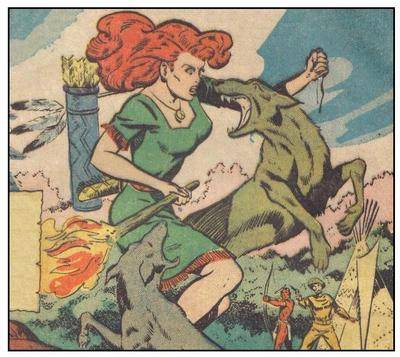
Both my mother and her sister had beautiful long bright red hair. In that the two were so close together in age and looked so much alike almost everybody mistook them for twins. Although I do not remember much about my mother I remember my aunt very well, and because of their look alikeness I always felt I had a good idea of what my mother looked like. My dad met her and her sister, i.e., my aunt, at the beach one day and after spending the day together offered them a ride home. My one-day-to-be future mother turned him down, telling him that her mother told her under no circumstances was she to ever get into a car with a stranger. If you recall from he photo in the main text the Mercer was an open bodied sports car with huge flat fenders. My dad took the two girls home riding on the fenders, so in essence, even though my dad was a stranger, they never got in the car, only on the fenders.
RED HAIRED FEMALE FIREBRANDS, THE WANDERLING,
AND MANY OTHER EARLY INFATUATION EXPERIENCES!
(please click)
(please click)
Footnote [2]
One day the person I have long given title to as a gorgeous raven-haired beauty in my writings told me through friends that she met a minor actor at a party that had the same last name as mine and for no other reason but to make small talk with the actor she mentioned me and the fact that my dad had worked for the studios in the late 40's. She said the man expressed interest in meeting me and when I told her I had no reason not to, she set it up.
We met at the location-shoot of a movie he was working on that ended up being given the title The Ghost In the Invisible Bikini, the last in the series of beach party movies that included such era-specific hits as Beach Blanket Bingo. They were shooting a dance scene around a pool with a gaggle of bikini clad well built girls and a few guys. During our talk, as it came out, he had a part in the 1948 film titled The Street With No Name, which was one of the three movies I cite my father having worked on while with the studios. The otherwise minor actor that had the same last name as my dad and my dad met during the production of that film.
THE GHOST IN INVISIBLE BIKINI WITH NANCY SINATRA
POOL SIDE. RAVEN HAIRED BEAUTY IN RED AS LULU.
(please click image)
THE BEST OF THE MAUGHAM BIOGRAPHIES:
- WILLIAM SOMERSET MAUGHAM
Good biography. Lots of Maugham graphics, from early childhood to late adult.
- W. SOMERSET MAUGHAM: A BIOGRAPHY
- MAUGHAM
- MAUGHAM IN INDIA
- LITERARY AMBULANCE DRIVERS
Everybody knows Hemingway drove an ambulance during WWI, nobody knows Maugham did.
SPIRITUAL GUIDES, GURUS, AND TEACHERS INFLUENTIAL IN THE RAZOR'S EDGE:
- BHAGAVAN SRI RAMANA MAHARSHI
- SWAMI RAMDAS
- YASUTANI HAKUUN ROSHI
- FATHER ENSHEIM
Includes a section on the missing years of the Razor's Edge- KOSTI
SRI RAMANA AND SOMERSET MAUGHAM
THE HOLY MAN, LARRY DARRELL, AND THE RAZOR'S EDGE
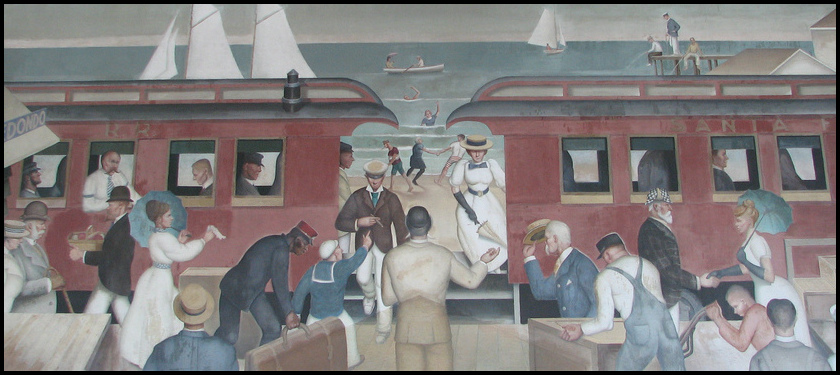
The WPA Federal Art Project side of things put large numbers artists to work painting murals in public buildings such as post offices, usually large wall-size murals depicting the history of the area. Most of those post offices have long been torn down, re-built, or the murals painted over with little or no concern for their historical significance.
The photo below shows a New Deal era mural from the old Redondo Beach post office carefully removed, saved, and years later reinstalled in the new Reondo Beach post office. The mural depicts typical summer time activity on the beach and a couple of the Pacific Electric "red cars" that serviced Redondo:
(photo source)
The CCC was quite different in that they provided manual labor type jobs relating to conservation and development of natural resources in rural areas owned by federal, state, and local governments. They also fought wild fires, built dams, and made man-made lakes. The following is from the source so cited:
(for larger size click image then click again)
Several of the really lean years during the Great Depression my godfather was a crew chief or foreman of a crew under the Works Project Administration, the WPA, or more accuratly it's sister counterpart New Deal government work program the CCC, Civilian Conversation Corps, that did a number of projects in the National Forest and along the Rim. His crews, long before the steel guard rails they have now along curves on major highways, built the stone and chain guard rails you see along the edge of the road as depicted in the graphic above. He was one of the people responsible for the proper construction and placement of the actual end product. Those same guard rails, built back in the height of the Depression, as flimsy as they are in their lack of ability to withhold any major incident today, still exist and still stand along many portions of the Rim of the World Drive to this day.