
From a series of lectures delivered at The China Institute in America
New York, New York
1976
IT CANNOT COME TO PASS THAT THE FRUIT OF A DEED WELL DONE BY BODY, SPEECH, AND THOUGHT SHOULD HAVE FOR A RESULT THAT WHICH IS UNPLEASANT, HATEFUL OR DISTASTEFUL. BUT THAT IT SHOULD BE OTHERWISE IS QUITE POSSIBLE.(see)
The concept of Karma
plays a very important role throughout Asia. Asian religions in general have established
the famous universal moral code based upon this law, that good deeds produce good effects
and bad deeds produce bad effects. However, it should be pointed out that Buddhism places
additional qualifications on this code: I. The Good or Bad Effect Is Neither Reward Nor Punishment The so-called good effect or bad effect is not a judgement nor is it given as a reward
or punishment by a supramundane authority such as God. The good or bad effect produced by
good or bad Karma is purely and simply a natural phenomenon governed by natural laws that
act automatically, with complete justice. If God has anything to do with it, then God must
also act according to this natural law. This cause produces this effect. That cause
produces that effect. God would not change this natural path because of his like or
dislike of a particular person.
II. Good and Bad Are Not Defined By A Human Code of Law. The good and bad referred to here are not defined by any code or law created by human
being unless such a code or law follows the natural path. For example, when democracy was
first established in the United States, women did not have the right to vote. At that
time, women who complied with that status were considered good and those who fought
against it were considered bad. The judgement was incorrect, however. The natural path is
that human beings are all equal, and thus the system which gives women equal voting rights
with men is truly the just one. Therefore, those who opposed the unequal voting system
were actually the good ones.
This law of Karma, or cause and effect, is so powerful that it governs
everything in the universe except, according to Buddhism, the one who is Enlightened or
who recognizes basic nature. Upon Enlightenment, the round of cause and effect loses its
significance, just as Samsara, or the round of birth and death, ceases with Enlightenment.
Since basic nature transcends all duality and is ultimate, there is no one to receive the
effect, whether it is good or bad, and no one to whom any effect can apply. This unique
explanation by Buddha of the nullification of the law of Karma is very important. I will
discuss it below. With this brief explanation of Karma as a background, let us now go a
step further to see how Karma works. In one of the Buddhist texts it is recorded that someone asked Buddha: Why are some women ugly but rich? Why are some women beautiful but poor? Why are some people poor but with good health and a long life? Why are some rich yet ill and short-lived? The Buddha's answers were: One who is ugly but rich was short-tempered in past lives easily
irritated and angered but was also very generous and gave offerings to the Buddha,
Dharma, and Sangha and made contributions to many sentient beings. One who is beautiful but poor was, in past lives, very kind, always
smiling and soft spoken, but was stingy and reluctant to make offerings or help other
people. The person who is poor but in good health and enjoying a long life was,
in his or her past lives, very stingy or reluctant to make donations, but was kind to all
sentient beings, did not harm or kill others, and also saved many sentient beings lives. The person who is rich but often ill, or who is short-lived, was, in
his or her past lives, very generous in helping others but loved hunting and killing and
caused sentient beings to feel worried, insecure, and frightened. The above examples give us some idea of why people on earth, although
all human beings, vary so much in appearance, character, lifespan, health, mental ability
and fate. It is even more interesting to note how much the circumstances in which a person
is born can influence his or her destiny. Which race, which nation, which skin color,
which era all these factors make a great difference. Would it not be more logical to
think that something was going on before one birth that caused all those effects than to say that it is
purely accidental or even to say that it is God's will? If a baby has no past life, then on what grounds
does God judge whether to reward or to punish that baby by causing him or her to be born
under different circumstances? Intent, thought and action should always be taken into consideration. Remember: IT CANNOT COME TO PASS THAT THE FRUIT OF A DEED WELL DONE BY BODY, SPEECH, AND THOUGHT SHOULD HAVE FOR A RESULT THAT WHICH IS UNPLEASANT, HATEFUL OR DISTASTEFUL. BUT THAT IT SHOULD BE OTHERWISE IS QUITE POSSIBLE.(source) "Karmic effect is the incomprehensible!" This statement of
Buddha suggests not only the complexity of karmic effects but also the difficulty of
predicting when a karmic effect will mature. Generally speaking, however, Karma is like the action of lighting a
candle. The candle will light the whole room immediately and will last until it is
consumed. Similarly, Karma has the following characteristics: These three points are rather condensed. I do not have time to give you
a detailed description of them. The following examples however, might help you to
understand these points a bit more: III. A comparison can be made of the magnitude of effects of various
kinds of Karma. Such comparisons are recorded in many Buddhist scriptures. I would like
to give you some examples to enable you to form your own ideas on how you may create
karmic effects of greater magnitude. In a further elaboration to the above regarding the Buddha's words as well as the meeting between Bodhidharma and Emperor Liang, regardless of what action one takes in regards to deeds or any merits or non-merits that may or may not follow thereof, the following should underscore both:
Proud of his knowledge and the contributions towards Buddhism, he asked Bodhidharma, "Since I came to the throne, I have built many temples, published numerous scriptures and supported countless monks and nuns. How great is the merit in all these?"
"No merit whatsoever" was his shocking reply.
Now, the emperor thought, he had often heard teachings from renowned masters who said, "Do good, and you will receive good; do bad and you will receive bad. The Law of Cause and Effect is unchangeable, effects follow causes as shadows follow figures." But now, this sage declared that he had earned no merit at all. Thus, the emperor was thoroughly perplexed.
The emperor had failed to understand Bodhidharma's words which means that one is not really practising the Buddhadharma if one does good with the desire to gain merit for oneself. It will be more like satisfying one's own ego, or promoting one's own welfare, or even for the sake of being recognized and appreciated by the public.
IV. Karma and free will. This topic has been discussed often. The question is: "Is there
any room for free will under the law of Karma?" A more penetrating question is:
"Might not free will be simply subjective opinion? So-called free will is also an
effect of Karma."
For the most part Hindu and Indian-based religious schools of thought, especially early ones, believed in and promoted the concept that Karma operates in a straight line, with actions from the past influencing the present, and present actions influencing the future. As a result, they saw little room for free will. A lot of that interpretation has permeated into western culture and thought, with Karma ending up being an unbending "fate" or "destiny" type of concept. However, Karma operates more closely with the Buddhist view as formulated by the Buddha, acting more or less in feedback loops, with the present moment being shaped both by past and by present actions; present actions shape not only the future but also the present. This constant opening for present input into the causal process makes free will possible. This freedom is symbolized in the imagery that Buddhists use to explain the process: flowing water: Sometimes the flow from the past is so strong that little can be done except to stand fast, but there are also times when the flow can be diverted in almost any direction. For further clarification regarding the possibility of modifying or changing the outcome of Karma, or as the Buddha says above "diverting the flow in almost any direction" see Power of the Shaman and Incident at Supai.
We could find many examples, all of which seem to indicate that there
is no room for free will under the law of Karma. Does this mean the fate of a person is
predetermined by his or her past Karma, that a person has no way to change it? As seen above in the Buddhist view of Karma
this is not the case. Why and how, then, can one change one's fate? Consider, for example, the work by Dogen Zenji, "Hotsu Bodaishin," in the twelve-fascicle edition, where he emphasizes the "arising of the 'Bodhi-mind' (bodaishin), which entails the vow to save all others before oneself" (ji mitokudo sendota). If causality is nothing other than "if 'a' then necessarily 'b'," then "Hotsu Bodaishin" becomes nonsensical, since no other causal agency other than the Self can then have anything to do with salvation. This would clearly imply a kind of personal atomic causality where the Self is isolated from all "external" influences--precisely the kind of position that Dogen is anxious to avoid.
We must remember that positive acts also produce positive Karma, and positive Karma interacts with negative Karma. In Dogen's "Kuyo Shobutsu," in the twelve-fascicle edition, we read that "There is great fruit from small causes, and great benefit from small acts." The implication here is that soteriological Karma is more powerful than negative Karma. In "Sanji-go," in the twelve-fascicle edition, we read a story from the Abhidharma-mahaavibhaasaa-`saastra (sec. 69) that tells of a good man (throughout this life), who, upon dying, finds that he is to be reborn in a hell. At first he is resentful, believing himself destined for a heavenly rebirth. But he then realizes that the hellish rebirth was for evil that he had done in a previous life. This realization (wisdom) changed his Karma such that he was in fact reborn in a heavenly realm.
These passages show that Dogen by no means had a simplistic and deterministic view of Karma. For Dogen, Karma is not a static, substantial, linear series of causes and effects. There is always the possibility of change, especially through the attainment of wisdom. Thus Dogen, without denying the causal structure of life and practice, rejects a rigid interpretation of Karma in favor of a fluid, Karmic, interdependent universe that depends upon our actions and understanding as part of its causal structure. Karma is such a vast subject that I could talk for hours without
exhausting the material. Topics like the following could be very interesting: Bhakti, as an example, differs sharply with traditional Hindu beliefs and basic Buddhism thoughts on Karma. This bhakti belief of Karma differs with the ordinary karmic conception of working off, or eliminating, good or evil Karma that the individual has developed, or earned, in previous lives. In the bhakti concept, Karma is set aside; the devotee expects the Lord will return Love for love and to ignore the predestined course of Karma. The question as to whether the Lord will abide by the ironclad law of Karma, or bestow his grace by removing it from the bhakti has fallen into the hand of the priestly castes, without resolution. See number 2 below and consider what happens if the concept of Lord as cited above is exchanged for the concept of identifying yourself with your basic nature.
With the general idea of Karma I have presented to you today, you may
be able to find the answers to those questions. In conclusion, I wish to emphasize two points: 1) Good or bad Karma will inevitably produce its respective effect. Our
daily doings, speech, and thoughts will affect our future. A wise person knows, therefore,
how to live properly. 2) Remember that the law of Karma stops operating and you become rid of
Samsara only by identifying yourself with your basic nature. How you may gradually
identify yourself with basic nature, and realize that it is yourself, is the essence of
Buddha's teaching. I
sincerely recommend that you study and practice it. Among all the hindrances to our cultivation of Enlightenment, the
greatest obstacle is our concept of Self. This is the core of all our ignorance and
suffering. For more on the reduction of that concept see: DEATH OF THE EGO: A Buddhist View. For some insights into potential "answers" to the three questions posed in the opening paragraph of this section go to: WHAT THE BUDDHA SAID.
(source)
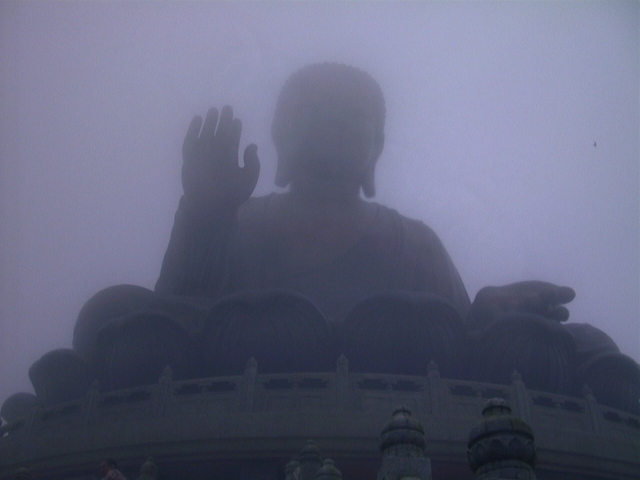
Fundamentally, our experience as experienced is not different from the Zen master's. Where
we differ is that we place a fog, a particular kind of conceptual overlay onto that experience
and then make an emotional investment in that overlay, taking it to be "real" in and of itself.
|
|


